>Facebook Message DramaGroups, Tweet @DramaGroups or email Outlook users
Click Here or email to contact@dramagroups.com subject 'Drama Groups - Reviews' include: Reviewer; Website; Region/County; Contact; Production; Review don't forget to attach photos & logo
All opinions expressed are those of the reviewer. www.dramagroups.com takes no responsibility for content or accuracy of any review.
Please remember when posting a review that it will be visible to the public.
VENUE: St Thomas' Church Hall GENRE: Drama CAST SIZE: 11 DIRECTOR: Joshua Gosney
SET DESIGN TEAM: Andrew Gosney, Ruth Gosney, Joshua Gosney, Michelle Drinkwater, Colin Drinkwater, Emmett Drinkwater
CHOREOGRAPHER: Janine Roberts
ASSISTANT CASTING DIRECTOR: Jennifer Woodward
THEATRE SOUND TECHNICIAN: Martin Pollard
SOUND, LIGHT AND PROJECTION DESIGNER: Joshua Gosney
PRODUCTION/THEATRE PHOTOGRAPHER: Colin Drinkwater (Jorube Portrait Photography)
PROMOTIONAL VIDEO DESIGNER/EDITOR: Samantha-Jane Twigg, Joshua Gosney
THEATRICAL MARKUP ARTIST: Lily Roberts
PROGRAM DESIGNER: Joshua Gosney
CHAIR/ASSOCIATE DIRECTOR: Michael Pirks
SECRETARY: Sam Duxbury
PRODUCTION CO-ORDINATOR: Ruth Gosney
COMMITTEE SUPPORT/MERCHANDISING: Jayne Dittrich
SOCIAL MEDIA: Samantha-Jane Twigg
HONORARY COMMITTEE MEMBER: Simon Choat
CAST LIST:
The Clerk - Neil Atherton
Fat Cat & Sloan - Andrew Kenny
The Boy & Sibling 2 - Emmett Drinkwater
The Manager & Sloane - Sam Duxbury
The Dessert - Michael Pirks
The Wife & Sloane - Ruth Gosney
The Duchess - Jayne Dittrich
The Waiter & Sloane's Sister - Barbara Hebde
Sloane & The Main - Lisa Rhodes
The Grandma & Sloane - Michelle Drinkwater
The Poor & The Starter - Janine Roberts
DATE OF PERFORMANCE: Friday 17th April 2026
DATE REPORT PUBLISHED: Sunday 19th April 2026
ADJUDICATOR ID: NSA0002
NSA LOGO ON POSTER: No
NSA IN PROGRAMME: Logo only on rear, No Banner
PROGRAMME CLASS: Best Original Design
THE REVIEW
REVIEW WORD COUNT: 1896
STRONGEST ELEMENTS - Janine Roberts - The Poor/The Starter
. Janine gave a strong and impressive performance throughout the production with great immersivity. Her Monologue towards the end of Act Two was memorable and stylised in her delivery.
Scene Three - The Snowy Forest
. This Scene was a collaborative effort from all parts of the production, to take the audience on the journey with The Clerk through his time of desperation, but through clever use of stylisation, Lighting sound and overall theatrical performance.
Cohesive Society
. This society has a strong, cohesive identity, with every member of the cast and crew showing genuine passion for their work. Everyone I spoke to demonstrated a clear sense of teamwork, consistently supporting one another.
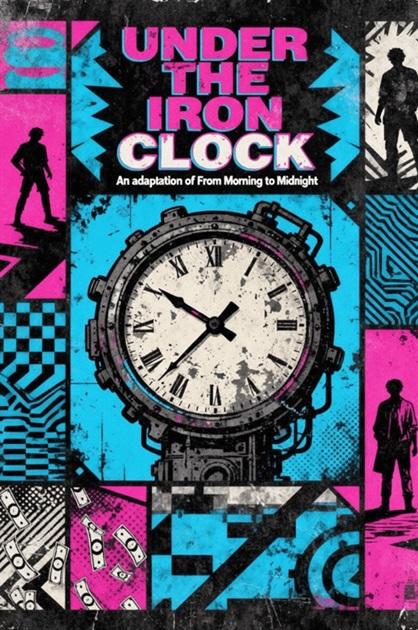
What a great opportunity it was to attend Soup Production's premier production of 'Under The Iron Clock', written and directed by Joshua Gosney. On arrival at the venue, we were greeted by Josh, who set the scene for the extraordinary events that were about to unfold. The production's mise-en-scène was immediately apparent upon entering the auditorium, reflecting a strong influence of German Expressionism-one of Josh's key areas of focus during his university studies and a major source of inspiration for the show. This transformed us into a 1980's abstract piece of theatre, which at times provided a vociferous vision to the production. Josh's vision and rustic approach was evident; the audience were positioned either side of a central raised platform leading up to the apron with a piano stage left that through artistic interpretation was used as an initial focal point for opening the show.
Upstage there was PVC frosted sheet used as the backdrop with a white warm glow, portraying shadows from hands pressing against the sheet, creating a sense of discomfort for the audience from the offset. Around the room eighties hits were subtly playing as if coming through a wireless radio sat on the apron. Throughout the production, the stage design remained deliberately minimal, featuring a chaise longue, PVC frosted screens, a piano, and a carefully limited selection of additional props. These elements were used to their full advantage in each scene, with the cast facilitating scene changes throughout the performance and even during the interval. This approach created a more immersive experience, allowing the audience to feel continuously engaged in the world of the production.
As the production started, we were introduced to the cast, Neil Atherton playing the lead role of the 'The Clerk.' Neil gave a performance using great physicality throughout, and delivered strong vocals throughout his performance. The emotive energy Neil portrayed created substance to the portrayal of a working man desperate to make a better life for himself and others. His performance remained consistent throughout and the characterisation was strong throughout his delivery. There are moments where I felt, in parts I wanted a little more from Neil's facial expressions to coincide with the play's avant-garde movement. However, this didn't detract from his overall performance. One of the key moments in the production which both my guest and I enjoyed was Scene Three, 'The Snowy Forest,' Neil's despair during the monologue in this scene held the audience on every word, symbolic gestures resonated throughout the piece such as the removal of his cuff links essentially releasing the chains restricting him to everyday life.
Andrew Kenny's opening role of Fat Cat established us in the bank creating a comedic atmosphere alongside Sam Duxbury who portrayed The Manager of the bank. Andrew's timing, character and wit was cleverly intertwined throughout the scene along with his physicality in facial expressions reacting to the ongoing events unfolding. At times it was difficult to hear Andrew's lines in the scene as occasionally his diction and projection dipped. However, this was rectified in his second role of the Greyhound Announcer - Sloane. This role was delivered with confidence, character and an overall sense of finesse to the role. He controlled the audience and cast during his time on stage and was a figurehead for the Sloanes as a whole.
Sam Duxbury, gave a clear and strong performance across all roles performed. As The Manager of the bank, she clearly commanded the establishment and scene, with character oozing from every word. Role after role she gave a strong performance. Every time she stepped on stage my eyes were drawn to her characterisation within each role. She did not detract from the scene but rather enhanced the overall journey we as an audience undertook. During her Sloane performances she gave picturesque detail in her facial expressions giving clear methodology behind every choice, styling each character suitably.
The Boy, played by Emmet Drinkwater, embodied the youth of 1980s society, variously representing an inheritor, a son, and the next generation. Emmet's vocals were clear, with crisp diction throughout, lending credibility to each role. As the Manager's son, they offered a perspective rooted in the experience of a typical child of the era, at times present yet largely unheard. It was lovely to see live music brought into the scene by Emmet for the clerks home, there was a nervous disposition when Emmet was on stage alone, but this lifted when supported by other members of the cast. This was evident in the Greyhound scene where as worker for the Sloanes, alongside their fellow cast, Emmet shone through, delivering confidence and projection. With further experience and development opportunities Emmet is one to watchfor the future.
A queer lens into the time was through the character of The Desert played by Michael Pirks, who is also the Chair and Associate Director of Soup. It was welcoming to see such a topic raised within the production, especially in such a stylised performance similar to that of a 1980's music video. Michael gave a strong and confident performance in every scene he was in, showcasing an unapologetic campness with the character - a true eighties drag queen. A compelling moment was during scene seven, the pink flamingo club, where until the very end of her life in the brothel, The Dessert was a clear play on sexuality and the sexualisation of these performers/workers, and Micheal performed this with determination and commitment.
Whilst the production was described as "weird and queer", I felt that at times the performance shied away from a pressing LGBTQIA+ topic: the grittiness of a queer performer's life - to display the misfortune and fear that 'The Dessert' became due to the hands of The Clerk, this would have been great to see; especially when inspired by Germanic expressionism.
Ruth Gosney played the role of the wife and Sloane, she displayed these characters with a clear delivery, good diction and clear definitions on genre change throughout the performance. She engaged well with other performers including Michelle Drinkwater when playing the role of Grandma during Scene four in The Clerks Home. Michelle brought an elegance of comedy to the role, without large amounts of dialogue she was able to entice the audience into the scene and create moments of great comedic timing, her facial expressions were a mixture of flat effect which complemented other emotions taking place in the scene, to highly animated expressions for key points of her dialogue. This was apparent throughout the performance resulting in a tele-novella-style summary of the scene.
There was a great use of tonality and clear distress in body language displayed by Jayne Dittrich playing The Duchess. She brought a touch of vibrancy to the stage along with great characterisation, even though she was grieving. She delivered a convincing accent in line with the character.
Barbara Hebden portrayed The Waiter and Dessert's Sister stood out during the pink Flamingo Club, her control and dominance over the other cast was clear, with good stage presence, clear diction and delivery of her dialogue. It would have been nice to see more emotion from the death of her sister, through the use of mannerisms and facial expressions, but I understand this a difficult emotion to portray, which I don't feel is out of her skill set. It would be nice to see further opportunities for developments in character in future performances.
The Main a confident and vibrant role was played by Lisa Rhodes who also played a Sloane. She delivered her roles with confidence and determination, adding value to the core points of each scene. She was great with her facial expressions, understanding and reaction to other characters around her and had a sense of vulnerability when asked to reveal her true self whilst playing The main. This was evident though her change in tone and body language during the scene. She delivered the roles well and gave pace to pace the storyline.
Janine Roberts delivered a strong and memorable performance, taking on roles including The Poor and The Starter. Her delivery of character was of a high standard with passion and control through each role she performed. She put effort and characterisation into each and every role, with great immersivity during the interval and throughout Act Two. Her monologue towards the end of Act Two was powerful with key moments where she commanded the stage bringing the story to its conclusion. She appeared to be the symbol of fate always around always looming and finally taking hold even after everything The Clerk had been subject to.
Standout moments throughout the performance included The Snowy Forest, where the simplistic use of shadow, minimal lighting, shredded paper as snow, and the cast physically shaping the stage to form a path of choice for The Clerk combined to create a powerful sense of tension, loss, fear, and emotional trauma. At moments throughout Neil's monologue lighting designed by Josh was cleverly stripped back, adding symbolic references to juxtapositions of poor and rich, loss and hope, which emphasised the key moments throughout the scene.
Lighting throughout the production was minimalistic but used effectively, based on the fact this produced on a minimalistic budget, its clever use and control gave additional key moments and pace to the show. The significant use of colour used throughout the whole production was during the pink flamingo scene which added further depth to the scene. While light bleed between areas is not typically complementary in most productions, here the effect-combined with the shadows cast by the tube lighting-contributed to a persistent sense of unease for the audience throughout the performance.
Another effective use of physicalisation occurred during the greyhound scene, where cast positioning and lighting conveyed the sense of an ongoing race at Belle Vue Greyhound Stadium. By utilising the central raised stage and combining movement with shadow, the ensemble created the impression of a large-scale crowd.
Sound designed by Josh and operated by Martin Pollard, gave an extensive range of emotions and feelings throughout the performance, from upbeat 1980's pop hits to cinematic ambient sound effects. While this complemented the performance, there were some issues with microphone timing and intermittent frequency faults that caused occasional dropouts. As I attended on opening night, these may well have been resolved in subsequent performances. However, they did not detract from the cast's work, who remained consistently professional throughout.
A Prominent line from the show that stood out to me was, "In the beginning we enter this world with nothing, and leave with nothing." This summarises the show as a whole for myself, I entered the space with very little knowledge of what I was about to see and watch. Both me and my guest walked away with a multitude of thoughts and feelings from the production, that we can't take with us when we're gone. Therefore, sharing these moments of inspiration and interpretation feels important in the present moment. I hope Josh and the entire team feel a strong sense of pride in what they have achieved, and that others are able to experience Josh's work and the world that has been created. Theatre of this nature, in such a raw expressionist form, is increasingly rare.
Congratulations to everyone involved. I would like to thank Josh and those who I spoke to from the society and wish you all the best for your next production.
Gig theatre is the theatrical form of the moment: part theatre, part rock gig, complete with the band onstage and often part of the action. If you're unsure of the template, think Manic Street Creature, Stereophonic or Teeth 'N' Smiles. Now arriving, with all the delicacy of a power chord at point-blank range, is Moonlight The Philip Lynott Enigma, an attempt to dramatise the short, combustible life of Thin Lizzy frontman Phil (Philip to family and friends) Lynott, dead by 36 after the usual rock-and-roll trinity of excess.
To underline the gig-theatre credentials, proceedings begin with Thin Lizzy's original guitarist Eric Bell recalling the formation of the band with Philip before obligingly strumming a little Whiskey in the Jar before exiting never to be seen again. Then, on a stage furnished with little more than a bench and a pub bar, in wander Oscar Wilde and Brendan Behan, apparently killing time in heaven - or, as we're told, TIR Na bhFilí, Gaeli for which might loosely translate as the Irish Dead Poets' Society - while they await Lynott's arrival. When he finally turns up, Wilde takes his leave and Behan stays behind to shepherd the audience through Lynott's biography via long, explanatory exchanges periodically interrupted by songs. Stage left, a four-piece band supplies the noise: some Thin Lizzy numbers and some earnest new material by John and Danielle Merrigan, who between them have written the book, music, lyrics and also produced the show.
Apart from Wilde, Behan and Lynott, we also get to meet his mother Philomena (Lynott never knew his father), a barman at the heavenly pub and a cartoon like "music journalist" who continues Lynott's story in act two in a mockney voice never coming close to emulating music journalists of the period.
The cavernous venue - a 3,500-capacity rock concert hall which wasn't nearly full - proves entirely hostile to anything resembling theatre. The sound is punishingly over-amplified; every line Brendan Behan utters lands like an assault on the eardrums. Lighting cues wander in late, if at all, while a scattershot video projection flickers meaninglessly upstage. There are baffling voiceovers (why does Canadian DJ "Kid" Jensen sound Irish?) and historical cameos that raise more questions than they answer. It's less a narrative than a fog of references. There's even some cod philosophising about life and poets thrown in for good measure just to remind us we're watching theatre.
There are, to be fair, glimmers. Peter M Smith captures something of Lynott's easy charisma and sings impressively, while West End musicals stalwart Mazz Murray pops up briefly as Philomena to remind us how close Lynott was to his mother. A couple of the original songs have a decent hook; in another setting - and with a far sharper dramaturgical scalpel - Lynott's story could make compelling theatre.
If I was a Lynott/Thin Lizzy fan, I'd probably give Moonlight The Philip Lynott Enigma a missand go off and see one of the many Thin Lizzy tribute bands instead.
Christian Durham directs the new musical by Carmel Owens, A Mirrored Monet The Musical now playing at Charing Cross Theatre. Set in 1916 in the studio of the older Monet, an artist who is finding himself struggling these days with failing eyesight has been hit with a creative block. Nothing he does can snap him back into painting again.
The new Musical focuses around the older Monet, played by Jeff Shankley, reflecting on his younger self and his marriage to Camille (Brooke Bazarian). The older Monet can see how selfish he has been over the years and that he neglected Camille's feelings and needs over his own all the time. Upon reflection, he is disgusted with himself.
Young Monet, played by Dean John-Wilson, portrays the keen young artist whose passion for his work over took everything else in his life. The arrogance of his youth and taking his wife from granted. Moving around to suit his own needs and paying little attention to her happiness.
There's a charm and calm in the paintings by the late painter Claude Monet. Camille is one of his inspirational muses that can be seen throughout his many paintings today. There are times during the Musical where Monet asks Chamille to strike some of the famous poses seen in his paintings.
There are a few good numbers during the performance and an exceptionally talented cast throughout, although it has been slightly drawn out and would benefit from editing and some of the songs cut from the production especially in the first act.
It is worth going to watch to see how the scene changes take place and the visual artwork changes behind the cast. The picture frames lay blank at the start and are filled with different paintings to depict where the storyline is taking place. The wonderful part is that it brings some of Monet's famous pictures to life.
I am sure this musical will attract an audience of Monet fans, and only time will tell what they think about the production. Personally, it was an interesting platform to present Monet's life on, but I think it would be better as an edited play version.
The Beekeeper of Aleppo isn't originally a book by Christy Lefteri. This tells the story about Nuri performed last night by understudy Aram Mardourian. Nuri is a beekeeper in the beautiful place Aleppo in Syria. A calm and simple life in the home he shares with his wife, Afra (Farah Saffari), an artist.
Surrounded by friends and family, the couple their lives are happy and fulfilled. Until one day, the war broke out, and everything they once knew and loved had gone, and they were forced to flee their home and old life in search of a new beginning in England.
The main body of the play is set during their journey to find a passage across to England. However, with the refuge camps rife with criminals, vulnerable genuine refugees like Nuri and Afra are an easy target to be exploited and taken advantage of.
The Beekeeper of Aleppo isn't a comfortable watch and with so much in the news at the moment about all the refugees arriving on boats it is easy to loose sight of the fact that these are all people who have been subjected to and seen some of the worse things human beings can do to one another.
The stories of other refugees fleeing war and persecution come in and out of Nuri and Afras' life as they are pushed from camp to camp while making their way across to England. How they could ever trust anyone again after what they experienced is beyond me.
Set designer Ruby Pugh combines the sands and landscape of Aleppo with a chair and a bed built into the sand. At first, it appeared strange, but as the story unfolds and the locations change, it all blends together perfectly. Combined with Ben Ormerods lighting design, bringing the softness of the Syrian sun onstage one minute, the next bright unforgiving glare of the Home Office immigration room.
It is Zsolt Balogh's video projections that really bring the stage to life. Especially when the refugees are at the mercy of the open sea. There's no scene changes, yet you can easily be transported to multiple places throughout the play.
Regardless of what you think about the people arriving on boats. This story is one that deserves to be seen and take away from it a new level of understanding about what all these people have to endure in order to get here. It's certainly not an easy journey on a luxury liner. It is an intense and emotional play that leaves an impact long after curtain call.
Operation Mincemeat tells the real-life story of when MI5 agents decided to use a stolen body and falsified invasion plans to deceive Hitler in 1943, which went onto win World War II. Yes, this actually happened. Although probably not in the same flamboyant style as this musical production.
MI5 agents are called to their boss, Johnny Bevan, played by Jamie Rose-Monk to offer a new decoy plan that could help the war effort and change Hitlers course of direction. Bevan doesn't work alone and has his adoring secretary, Hester, played by Christian Andrews, who oversees the efforts and liases with the agents.
Andrews is an incredible actor and plays a wide range of characters throughout the musical with believable ease from the American Air Force pilot to the flamboyant mortuary manager.
One of my favourite characters, played by Rose-Monk , is Spilsbury, who sweats rather a lot apparently. The delivery in the briefcase scene is brilliant, and I can't imagine how long it is to perfect, especially with the phone cables.
Alongside are cast members Holly Sumpton Ewen Montagu, Charlotte Hanna-Williams in the role of Jean Leslie and Seán Carey playing Charles Cholmondeley, who originally devised the plan of Operation Mincemeat. Each of their performances were incredible and such a strong rapport throughout.
The speed of the costume changes alone is worth watching. One minute, the cast is on a submarine and the next German soldiers. Incredibly slick and professional performers.
Even if historical World War II productions are not normally your choice of entertainment. Operation Mincemeat might just change your opinion. From start to finish, the Musical had me transfixed to the stage as the comedy farce unfolded before me. This is one of those musicals that has all the right ingredients for a fantastic night at the theatre. Definitely not one to miss as it tours around the country and across the continent.
Tim Foley's new horror play, It Walks Around the House at Night, directed by Neil Bettles for ThickSkin, brings an unsettling energy to Southwark Playhouse. The story follows Joe, a struggling actor hired to impersonate a ghost at Paragon Hall, only to find himself facing real threats as the situation grows sinister and his fee increases dramatically.
Themes of class and privilege are woven through the plot, examining the risks people take to survive, enriching the narrative without distracting from the suspense. However, the presence of multiple supporting characters, even his ex-boyfriend, appears to lessen the sense of isolation and undermine the horror, providing too much support for Joe.
Despite the convoluted plot and occasional distractions, Naylor's performance is outstanding, bringing Joe to life as a real character. The physical presence of the Dancer (Oliver Baines), whose story echoes Joe's, adds a unique layer that distinguishes this production from other horror offerings in London.
The technical elements shine: Pete Malkin's sound design and Joshua Pharo's lighting combine to deliver effective jump scares, while Bettles and Tom Robbins' set design allows apparitions to appear and vanish in bursts of light. The stage, facilitates seamless transitions from indoors to outdoors, echoing the play's central motif: the property's demons roam the perimeter, not the interior. Pharo's video projections add atmosphere, though some visuals feel superfluous; sometimes less would be more.
Ultimately, the script's numerous ideas and eagerness to reveal hidden elements diminish its overall impact, with too many glimpses of a shadowy. Despite this its mix of horror and social commentary makes it a notable addition to London theatre.
The Complete Works of William Shakespeare (abridged) by Reduced Shakespeare Company condenses all of the plays written by William Shakespeare into a one hour and thirty-five minute's show, covering a brief outline of all the plays, plus a quick look at the sixteen sonnets along with more indepth staging of two of the more famous plays.
After nine years running in the West End of London, The Complete Works of William Shakespeare (abridged) is currently on tour across the country. Catching this performance at Salisbury Playhouse, I can understand why it had huge success and ran as long in the West End.
The cast of three in tonight's performance were Tom Pavey, Woogie Jung, and understudy Kiran Raywilliams. They have a strong rapport on stage and engage with the audience and break the fourth wall throughout with some audience participation required.
Writers Adam Long, Daniel Singer, and Jess Winfield have updated and reinvented this latest touring production. Which means if you did see it in London, then it's worth catching again to watch out for these changes.
The energy and knowledge of the works of Shakespeare are incredible, but as it is delivered at speed, which means you need to pay attention if one of your favourites isn't one of the more popular Shakespeare plays.
There's mini edited versions of two of the more popular Shakespeare plays. Hamlet and Romeo Juliet. In my opinion, the best version of Romeo and Juliet I have seen. It gets straight to the point as let's face it. Most people know what the storyline and ending are already, so there's no spoiler alerts.
For more information about The Complete Works of William Shakespeare (abridged) and future productions at Salisbury Playhouse, please use the links below.
David Baddiel wrote a one man show called "My Family: Not The Sitcom". To avoid any confusion, the latest production at Marylebone Theatre could have been called Yentl: Not The Barbra Streisand Musical for this production couldn't be further from the sentimentalism that pervades the film that Isaac Bashevis Singer, the writer of the original storythought was a splashy production that has nothing but commercial value".
This Yentl, is the acclaimed Australian production from Kadimah Yiddish Theatre now making its London premiere. Superbly directed by Gary Abrahams, this bold adaptation by Abrahams, Elise Esther Hearst and Galit Klas, strips away the schmaltz of the more famous interpretation and returns the tale to something darker and more spiritually charged and shapes it into a lean, atmospheric piece of theatre that feels closer to folklore than traditional drama.
Set in a Polish shtetl in the 1870s, the story follows fiercely intelligent Yentl, a young Jewish woman forbidden by religious law from studying the sacred texts. When her father dies, she disguises herself as a man and enrols in a yeshiva, plunging into a world of scholarship that has always been closed to her. The deception opens the door not only to intellectual freedom but also to emotional chaos, as her new identity entangles her with fellow student Avigdor and the thoughtful Hodes. What surprises is the focus on the sexuality of the three main characters and its depiction of gender identity and the naivety of their confusion.
Amy Hack gives a quietly compelling performance in the title role. Her Yentl is not a fiery rebel but a restless thinker, driven by curiosity as much as defiance. Hack captures the character's exhilaration at discovering a world of ideas, while never losing sight of the danger and loneliness of living a double life. It's an intensely focused performance that anchors the whole production. She's well supported by Genevieve Kingsford as Hodes and Ashley Margolis as Avigdor who both give splendid, nuanced performances.
The staging uses a curtain to great effect and Dann Barber's towering set is almost brutalist in its architecture. The lighting by Rachel Burke and the sound design from Max Landvert add to the atmosphere of this already atmospheric piece of theatre. The bilingual script - shifting between English and Yiddish with surtitles - adds an evocative texture, grounding the play in the cultural world that produced it while making the emotional stakes feel immediate.
One of the production's most unusual devices is a mysterious onstage presence known as "The Figure", played with impish authority by the wonderful, mesmerising Evelyn Krape. Acting as a manifestation of Yentl's inner urges and doubts, the character turns the drama into something almost mythic - part psychological study, part spiritual fable. She narrates, plays various parts and at times seems to guide the story to her will driving the narrative forward as it builds towards its inevitable conclusion.
Yentl has great intelligence and originality which makes it consistently compelling. In an era when theatre often plays it safe, Yentl feels thrillingly uncompromising: a story about faith, gender, sexuality and knowledge told with imagination and nerve.
There was a time, not so long ago, when The Choir of Man felt like a well-kept secret: a scrappy, big-hearted hour of song and spoken word tucked away in a makeshift pub, equal parts gig, theatre and late-night lock-in. Back in 2021 at the Underbelly in Earl's Court, just as the world was blinking back to life, its charm lay not only in the raucous camaraderie of its bearded, beer-swilling performers, but in the gentle, homespun reflections threaded between the songs by original narrator Ben Norris, an award-winning slam poet whose words gave the show unexpected depth.
Now, as the production embarks on a UK tour following a longer West End run, it has undergone a transformation. Bigger, louder and more polished, The Choir of Man has traded some of its intimacy for scale. The running time has expanded to a two-act, 90-minute affair, and while Norris's writing remains, he has stepped aside as performer. In his place, Oluwalonimi Owoyemi takes on the role of "Poet", guiding us through the evening with warmth and charisma, if with less of the understated nuance and reflectiveness that once grounded the show.
The setting remains the same: a lovingly detailed old-school pub called The Jungle, complete with sticky floors, battered furniture and an upright piano. As we're told early on, while most pubs boast a darts or football team, this one has a choir - and what a choir it is. Each member embodies a recognisable archetype: the Barman (Joshua Lloyd), the Romantic (Sam Walter), the Beast (Rob Godfrey), the Hard Man (Levi Tyrell Johnson), the Joker (Ben Mabberley), the Handyman (Jack Skelton), the Bore (Aaron Pottenger) and the Maestro (Gustav Melbardis), whose pianistic prowess anchors the evening.
The setlist is eclectic, veering from 'The Impossible Dream' to 'I'm Gonna Be (500 Miles)', via 'Escape (The Piña Colada Song)', 'Chandelier' and 'Dance with My Father'. The vocal arrangements (by Jack Blume) are rich and stirring, the harmonies frequently exquisite, the soloists powerful. When the cast strips things back and performs acoustically, the show briefly reconnects with its roots - these are its most affecting moments.
Whilst the cast all play their own instruments, less successful are the occasions when a heavy backing track kicks in, the amplified drums threatening to shake the pictures off the walls. It's here that the production's expansion feels most at odds with itself, as if unsure whether it wants to be an intimate pub singalong or a full-blown arena-style concert. Audience interaction remains a key part of the experience: pints are handed out, crisps and beer mats are flung into the crowd, and there's a sense of orchestrated chaos that keeps the energy high. It's undeniably fun, if occasionally a little forced.
The Choir of Man has grown into a global hit, even picking up an Olivier nomination along the way. While this slicker incarnation may have lost some of the quiet magic that once set it apart, it remains an undeniably uplifting night out. It's boisterous and unabashedly crowd-pleasing - the kind of show that invites you to sing along, raise a glass, and leave with your spirits lifted. Personally I missed the subtlety of the earlier iterations, but having said that, it's a joyous show, and if last night was anything to go by, audiences around the UK are going to love it.
Anticipation hung in the air at the world premiere of One Day: The Musical at the Royal Lyceum Theatre. Regulars might have been surprised to find the auditorium reconfigured in the round, the audience facing one another across the stage. For a theatre accustomed to a traditional proscenium, the shift is initially disorientating; glancing across at fellow theatre-goers becomes part of the experience.
Emma and Dexter's story begins in 1988, and a digital clock marking the year helps keep the audience oriented as time advances. There is something almost reminiscent of Back to the Future's time machine, in the way the passing years tick before us. Based on the novel by David Nicholls, later adapted for television, the story arrives with a sense of familiarity already attached.
Despite its musical form, few of the songs leave a lasting impression. They lack the bite or emotional potency of recent Lyceum theatre productions such as Wild Rose, whose numbers linger long after the curtain falls. At times the musicians stationed in the royal box become a distraction from the action unfolding on stage.What works far better is the choreography. The colourful bursts of movement suit the theatre-in-the-round staging, particularly during the larger ensemble sequences such as graduations, restaurant scenes and moments of chaotic celebration which flourish in the space.
As Dexter, Jamie Muscato recalls the louche/laddish ways of Hugh Grant's Daniel Cleaver from the Bridget Jones films. Working in London media, Dexter carries the same smugness and emotional immaturity that Muscato leans into effectively. Sharon Rose, meanwhile, brings warmth and intelligence to Emma Morley, creating a far more grounded and sympathetic figure. Josefina Gabrielle is also excellent as Dexter's mother, Alison, appearing at different stages of his life from the pride of his early adulthood to the poignancy of later illness, grounding the story whenever she appears.
Credit must also go to the creative team for making the theatre-in-the-round staging work so fluidly. The production makes imaginative use of the space, allowing scenes to flow quickly as the years pass in Emma and Dexter's lives. Edinburgh also appears from a different angle for many in the audience both culturally and socially. Like the digital clock marking each passing year, One Day: The Musical moves steadily through the decades. The story that made Nicholls' novel popular remains intact but perhaps it's time for new stories about the city and Scotland in general to emerge.
2:22 A Ghost Story is a very unique theatre experience. You go in expecting a thriller, and that is certainly what you get.
Throughout 22 A Ghost Story, it makes use of some cheap jump scares. However, in one of the most bizarrely unifying experiences I've had in theatre, I found myself and my fellow audience members laughing at our jumpiness after each scare, which kind of made them worth it.
Once you have settled into the rhythm of the play, a story unfolds, which is genuinely funny, philosophical, and enthralling. If you've heard of 2:22, then you've most likely heard that there is a big twist in the play - and knowing this when you take your seat is no bad thing.
Writer Danny Robins clearly wants us to think and analyse as we watch, and each of the four characters gives us plentiful food for thought. They are all multi-faceted and interesting, and most importantly, they all keep you guessing. Understudy Paul Lockett was superb, as were principles Shvorne Marks, Grant Kilburn, and Natalie Casey. I forgot that I wasn't actually eavesdropping on a conversation between two dysfunctional couples for much of the play.
Likewise, the set design is fantastic. An open plan kitchen and living room under renovation that wouldn't look out of place on Grand Designs, with an outside garden area to the rear, and an enormous red LED strip around the proscenium has no business being so unobtrusive on stage.
Overall, this is a play that you should absolutely see. Act 1 is possibly guilty of not getting to the point quickly enough, but so are so many excellent plays. It may not be your favourite show you see this year. You may not like the twist or the jump scares. But the story was so powerful that when leaving the theatre, there was a hum of excitement from everyone to discuss what we'd all just watched. 2:22 A Ghost Story unexpectedly brought out the community and camaraderie of theatre, and I want to go and watch it again.
I am old enough to have seen Grease in the cinema when it was first released in 1978 and have ever since been a fan of the high school love story. The idea of Grease the film being mixed with Greek mythology to make a new parody sounded too good to miss.
The three "fates" lead the evening's entertainment. Grace Kelly Miller plays Atropus alongside Lara Beth Sas as Clotho and Christopher Patten-Walker as Lachesis. They think they are going to decide who will be matched with who as the pupils return to Olympus Academy and the book of Fates is being written.
Sandy and Danny are replaced by Zeus (Peter Camilleri) and Hera (Philippa Leadbetter), who both attend Olympus Academy. Although they don't realise this after their brief summer holiday fling.
A special mention has to go to Christopher Patten-Walker, Ollie Thomas Smith, and Safia Bartley. Each of them play completely different characters throughout the performance and are incredibly fast at switching between them. The backstage must be chaos!
It has comedy moments, plenty of music that almost matches the original Grease soundtrack, and my heart sank at times when the lyrics were different (expected though due to copyrights) and the characters names are firmly placed in Ancient Greece mythology. Ancient Grease is written by Lady Aria Grey and directed by Dan Wye.
The Vaults is the ideal venue to stage a production like this. The runway staging allows everyone in the auditorium to see the whole space and not miss any of the action. Although there is some minor audience participation, avoid the front row if that's not your "thing."
A special mention goes to Caitlin Mawhinney, Costume Designer, for an excellent range of costumes bringing out each characters' persona.
The entire cast is excellent, and the energy levels never falter throughout the two hours and forty minutes. Although that's a longer running time than the original film of one hour and fifty minutes and would definitely benefit from being edited as it felt like it dragged towards the end.
The circus has arrived this week at the King's Theatre in Portsmouth. Set against the beautiful backdrop, the Circus looks like it is at home in the King's Theatre and could easily have been made to measure exclusively for the venue.
Barnum The Circus Musical is about the life of P.T. Barnum is the famous American showman, businessman, and politician. Who is remembered for promoting celebrated hoaxes like the oldest woman in America who didn't look a day over 25 in the Musical.
The lead performance in Barnum the Circus Musical is billed as Lee Mead. However, due to unforseen circumstances, his understudy stepped in on press night. Tom Sterling took to stage and immediately won the audience over.
Sterling played the role of Barnum with confidence and ease. Although I dare say he was incredibly nervous knowing that the eyes of the press were upon his every move. Performing alongside him in the role of Charity Barnum was Monique Young. Charity stood by Barnum and each of his schemes supporting him even when he made the situation difficult.
Eamon Cox plays the Ringmaster and narrator through the Musical, as the audience watches Barnum climb the heights in the entertainment and society world. Cox also delivers some circus tricks along with the rest of the circus performers.
What I absolutely loved about this production is the way that I have stuck to traditional circus acts. Picking up on the obscure and ignoring members of society. For example, General Tom Thumb, played by the extremely talented Fergus Rattigan Size, doesn't matter when you have a large stage presence.
Choreographer Oti Mabuse and director Jonathan O'Boyle bring the beauty and wonder of the Circus to life. There's no other gimmicks or tricks used beyond the hoaxes created by Barnum during his lifetime. A wonderful entertaining reminder of how the world of entertainment used to be.
A special mention has to go to Penny Ashmore in the role of the opera sensation of that time, Jenny Lind. Ashmore has a wonderful operatic voice and was met with rapturous applause after she sang.
For more information about Barnum The Circus Musical and some really good upcoming plays coming to King's Theatre Portsmouth soon, please use the link below.
William Shakespeare wrote Othello over 400 years ago, which makes the job of reviewing easier as there are no spoiler alerts, as many people know the storyline and the tragic ending. Despite how long ago this play was written, human nature has changed that much and the themes running throughout Othello of power, jealousy, manipulation and control leading to catastrophic consequences remain relevant today.
Ashley Mejri plays the role of the Moor, Othello, who has won the heart of Desdemona (Lottie Burns), much to her Father Brabrantio's disgust played by Jim Tracey. Who doubles up in the role of Montano as Brabantio has a small role.
The storyline is based around Othello believing that his wife has been unfaithful to him after she misplace a hankerchief that he had given as a token of his love. The hankerchief is later '"apparently" found in the bed chamber of Cassio (Sam Claridge), and this is clear evidence that Desdemona has been unfaithful!
Othello might have listened to reason had it not been for the scheming and manipulation taking place at the hands of Iago played by the incredible actor Ben Lynn. Throughout the entire performance, Lynn never slips out of character or falters. His body language and twitches all add to the underhanded behaviour of Iago. I found myself mesmerised by his whole performance. Some actors are a natural fit to play Shakespeare characters, and Lynn is one of those.
I recently saw the West End production of Othello starring Toby Jones in the role of Iago, and after that, I thought I wouldn't see anyone else who could rival that performance in a character. However, Lynn has achieved this.
The original musical score by Will Pickering adds the ingredients of suspense and dramatic effects to The Discarded Nut Theatre Companies version of Othello. Along with the lighting effects by lighting designer Katy Nixon, who works against the blank white staging that represents the archways that can be found around large stately homes.
Costume designer Bebe Elkins-Payne creates the indulgence of the characters' status by using rich coloured fabrics and adding gorgeous costume jewels onto shirt lapels, which catch the light during the performance. A simple yet effective way to add status accessories and show off the wealth to the characters.
Director Noël Jones and executive director Harriet Morris have bought to the intimate stage of the Nutshell Theatre a production to rival any large budget production I have seen previously.
Playing at the Nutshell Theatre in Winchester until March 21st 2026. This is a version of Othello well worth catching before it finishes.
Despite the promise of spring, the evening in Edinburgh was wet and cold, making the warmth and colour of the Playhouse all the more inviting. Families and children shook off umbrellas and coats, ready to be carried away by the mischievous, imaginative world of Matilda the Musical. Fittingly, the performance I attended fell on World Book Day, a reminder of the story's enduring celebration of books and imagination in a world increasingly dominated by glowing screens. What still shines through is the unmistakable voice of Roald Dahl. His sense of mischief, exaggeration and gleeful rebellion against pompous adults remains intact in the stage version. I was a devoted Dahl reader as a child, and the humour here feels instantly recognisable. There is a slightly rebellious, knowing tone that delighted a generation of young readers who are now parents in the audience. Watching with my own 13-year-old daughter, laughing at the same jokes, it was striking how humour cascades across generations.
The musical also retains Dahl's fondness for stories within stories. Matilda's tale of the escapologist and the acrobat unfolds like a classic Frame Narrative, gradually revealing how imagination can illuminate the truth hiding in plain sight. It's a clever narrative device that reminds us storytelling isn't just Matilda's escape; it's her way of understanding the often wicked world around her. The young performers carrying the title role do so with remarkable control. Madison Davis plays Matilda tonight, capturing her intelligence, curiosity and quiet defiance, while Carter-J Murphy as Bruce delivers the musical's most gleefully anarchic moments. The chocolate cake scene, in particular, drew roaring laughter from children and adults alike, as Bruce squared up to the enormous cake with determination and delight. Another highlight, "When I Grow Up," sees the children's voices fill the theatre with hope in these troubled times.
If Matilda is the story's quiet centre, then Miss Trunchbull is the dark storm that circles it. Played with booming authority by Richard Hurst, the monstrous headmistress arrives like a force of nature. Hurst delivers with a military bark, thunderous threats and exaggerated anger. By contrast, Tessa Kadler's Miss Honey brings a gentler presence, providing the quiet emotional anchor the story needs and reminding us that kindness, not just cleverness, is what ultimately changes the world.
The parental figures are played with broad, cockney-inflected comedy, and Adam Stafford and Rebecca Thornhill make the Wormwoods a hilariously rough-edged pair. Stafford's hair-styling antics drew big laughs, while Thornhill's Mrs Wormwood exudes perfectly timed vanity. The exaggeration is clearly a theatrical device rather than social realism, but it underscores the absurdity of the adults and makes Matilda's small acts of rebellion all the more satisfying. The ensemble numbers and Tim Minchin's clever score provide constant energy. Songs dart between wordplay, satire, and genuine emotion, while choreography keeps the stage alive with motion and mischief. The company turns every number into a small riot of colour, movement, and joy, reminding the audience that imagination is as vital as ever.
At its heart, the story suggests that rebellion is sometimes the only sensible response to unfairness. In Dahl's universe, the adults in charge are often ridiculous, cruel, or inattentive, and the children's refusal to quietly accept it becomes an act of imagination rather than disobedience. Watching a theatre full of young people cheer Matilda's defiance felt less like mischief and more like a reminder that questioning unfairness is a valuable instinct, no matter how old you are. On a night celebrating books, Matilda felt like more than just a musical. It was a reminder that stories can still spark imagination, shape a sense of humour, and occasionally encourage us to challenge the unfair things in front of us. From the small victories of Bruce Bogtrotter to the quiet courage of Matilda, it's a joyous, witty, and surprisingly profound celebration of childhood, reading, and rebellion.
There is a particular magic in lunchtime theatre and Someone's Knockin' at the Door, part of the Play, A Pie and A Pint series, captures it with gentle precision. In the intimate Traverse Theatre space, the boundary between audience and performer almost disappears, allowing every glance, pause, and knock at the door to carry extra weight.
Written by Milly Sweeney and inspired by a true story, the play follows Jack and Kathy, a working class couple whose memories and adventures are recalled with humour, tenderness, and occasional wistfulness. Jonathan Watson and Maureen Carr, two of Scotland's most accomplished and beloved performers across stage and television, bring them vividly to life. As Jack and Kathy, they embody the archetypal Scottish pair, full of the contradictions of Scottish life: Catholic versus Protestant, art versus commerce, and rural versus urban.
Watson's Jack is occasionally a dreamer, swept along by nostalgia and music; Carr's Kathy is firmly grounded, a pragmatic counterbalance. Jack initially struggles to persuade his pregnant wife (unbeknown to him) to embark on the road trip at the story's centre, but wins her over with the promise of a fish supper, a small, deliciously domestic incentive that reveals the intimacy and humour of their relationship. Their bickering is often comic; beneath it hums genuine affection, even as the story ultimately reveals that the couple divorced. In performance, however, the warmth and chemistry between Watson and Carr make Jack and Kathy feel fully alive, capturing the joy, tension, and shared history of a real relationship.
Jack's love of The Beatles is a central aspect of his character. Like many men of his generation, it is a language through which he expresses love and emotion, it also helps him develop a more positive outlook on life. His recounting of the 1976 journey in search of Paul McCartney's hideaway in Campbeltown, part pilgrimage, part adventure, becomes a meditation on youth, obsession and the enduring power of music as well as teenage dreams.
The narrative unfolds through the eyes of a grandchild working on a school project, a device that allows memory to flow naturally. Within this storytelling are cherished moments, deep sadness, bursts of laughter, and great joy. It is here, in the interplay of past and present, that the play finds its emotional centre. The minimal set and close proximity of the audience to the action amplify the intimacy, making you feel as though you are sitting at the scullery with Jack and Kathy, listening to their memories as if they were your own. By the final knock, laughter, nostalgia and a touch of wistfulness linger together. Someone's Knockin' at the Door is relatable and elegant in its simplicity, gentle in its observation and subtly thrilling in the way it reminds us of the stories, contradictions, and music that shape our lives.
Single White Female tour performs in Woking's New Victoria Theatre from 3rd to 7th March. It arrives on stage with a contemporary twist, reimagining the 1992 psychological thriller for a modern audience steeped in social media, start-up culture, and the pressures of single parenthood. At its centre is Allie, played by Lisa Faulkner, a newly divorced mother attempting to rebuild her life in a run down apartment while juggling a fledgling tech business and the demands of her teenage daughter, Bella.
When Allie's ex-husband abruptly halves his maintenance payments, financial strain forces her to take in a lodger. At first, Hedy, played by Kym Marsh, appears the ideal tenant-polite, helpful, eager to fit in. But as she embeds herself deeper into Allie's home and personal life, the atmosphere shifts, and the cracks start to show as Hedy gets closer, almost obsessed with Bella.
The production unfolds on a single, cleverly designed set that delineates the apartment's kitchen and living areas while allowing for swift transitions through a series of unseen rooms. It's a simple but effective staging choice that keeps the focus firmly on the characters' psychological unravelling.
Unlike many thrillers, the play resists leaning heavily on a suspenseful score; instead, it uses sparse soundbites and brief musical clips to punctuate scene changes. A well-timed nod to Radiohead's Creep was personally appreciated!
While the play never quite reaches the level of fear its genre suggests-it succeeds as a character-driven exploration of loneliness, identity, and blurred boundaries. The audience reactions, however, ranged wildly - from gasps to chuckles during its brief moment of graphic violence. Some audience members found humour in the sometimes predictable dark moments, whilst others seemed genuinely shocked.
Fans of the original film will find interest in how its themes have been updated for a digital age, even if the stage version opts for tension over terror.
Gary Wilmot's debut play While They Were Waiting is a charming two-hander play starring Wilmot and Steve Furst. If nothing else, it is an absolute treat to be able to see two longstanding incredibly talented actors performing in an intimate space and watch their craft up close.
How does a friendship start? Bix, played by Steve Furst, is waiting. In fact, he is always waiting and prides himself in being an incredibly patient person when it comes to waiting. This is a useful trait to have as he is now waiting indefinitely for the yellow door to open. He has been invited to the place to meet the person who lives there.
Mulberry arrives first with his umbrella and briefcase, dressed in a smart suit. However, the umbrella is just a skeleton now, and if it rained, it would offer no protection from the rain! Although Mulberry isn't in the slightest bit concerned about that and us simply happy to be doing his favourite pastime, waiting.
Writer and performer Gary Wilmot plays Bix, who decided to join and chat to Mulberry whether he likes it or not. At first, Mulberry isn't interested in striking up any form of friendship. However, Bix doesn't give up easily and isn't going anywhere else.
The dialogue is rich and funny in places. Wilmot and Furst have a wonderful onstage rapport, and the majority of the conversations that take place between the "strangers" come across as organic and natural. It was an absolute pleasure to watch.
Hannah Danson's set is bright and inviting with the bright yellow door and fluffy white clouds. An enticing sunny day setting is the perfect setting for somewhere for Mulberry to wait. Even though he hasn't any idea what he is waiting for.
Broken Glass by playwright Arthur Miller was written in 1994. The play's title was on Kristallnacht, which is also known as the Night of Broken Glass.
The play was set in Brooklyn in 1938. It follows the story of Sylvia Gellburg (Pearl Chanda), a Jewish housewife, who suddenly finds that she's paralysed and unable to walk. Her husband, Philip Gellburg (Eli Gelb), is confused and frustrated about his wife's condition and not particularly sympathetic to her frustrations.
Sylvia is absorbed with the uprising in Germany of Hitler and isn't able to look away from the attacks that are taking place in Europe against the Jewish community. Nobody else appears to take her concerns seriously and tell her it will pass.
The couple asks Doctor Harry Hyman (Alex Waldmann) to try and help Sylvia walk again. Hyman spends hours with Sylvia, talking and attempting to understand what has happened to cause her condition. He decides after time that her condition is psychological caused by the trauma of events taking place in Europe.
I did struggle to suspend my disbelief that Sylvia and Philip had been married in a "sexless" marriage for twenty years as the two actors had been cast wrong and don't look old enough. Although they both give strong and powerful performances in the roles of Sylvia and Philip.
Although I found some of the play muddled in places and couldn't always follow what is happening, especially when Philip is sacked. Although the production is two hours long with no interval, it passed by fast, and I found myself being drawn in by the characters and the storyline. A special mention has to go to the two goldfish on the stage, adding in a touch of domesticity to the set.
James Bye, Natalie Casey, Grant Kilburn and Shivorne Marks star in the latest touring production of the successful play 2.22 A Ghost Story by Danny Robins
Jenny played by Shivorne Marks is convinced the new home she shares with Sam (James Bye) is haunted and at 2.22 am she hears the same thing coming through from their baby's room every morning.
The play is set during a dinner party with the couple predominantly arguing over whether their new home is haunted or not. Sam is a non-believer and puts everything down to logical explanation.
However, their dinner guests Lucy (Natalie Casey) and Ben (Grant Kilburn) are not so sure that ghosts are a figment of Jenny's imagination and as the alcohol flows tempers become tested. Ben has something in his past that might help Jenny find a resolution.
Stage designer Anna Fleischle offers a interesting platform to allow the audience to still see parts of the original features and wallpaper against the beginning of the "improvements" which are taking shape. Although Ben suggests that these improvements are ripping the soul out of homes that saw generations of loving families living there before.
The lighting effects by Ian Dickinson add plenty of dramatic effects throughout the play especially when the strobed lights around the stage light up in bright red hiding the stage behind allowing scene changes to take place without the audience knowing what to expect next.
The production is pretty good and with the audience jumping around me the element of surprise caught many off guard. There's nothing gory or blood thirsty about this play, it's predominantly psychological as Jenny and Sam argue about the existence of Ghosts apart from the deafening Foxes' screams.
Reviewing 2.22 A Ghost Story offers many challenges as its full of spoiler alerts which I am not willing to divulge.
Spitfire Girls by Katherine Senior is the moving story about two sisters who are working on the family pig farm near Southampton. It's 1944 and World War II is taking place and they both want to do their bit for the war effort. Answering an advert to the Air Force asking for men and women ATA recruits their letters of acceptance arrive and their lives are changed forever.
The ATA stood for Air Transport Auxiliary, a civilian organisation that was hugely important during World War II as their serving members moved aircraft across the country between factories and various positions freeing up serving officers from these tasks.
Katherine Senior plays the role of the oldest sister Bett whose quieter and doesn't particularly engage in confrontation much to the frustration of her younger sister Dotty (Hannah Morrison) whose outspoken and spirited yet passionate and caring. Despite their differences, they are incredibly close and are by each other's sides throughout.
Spitfire Girls follows the highs and lows of the sisters serving time. The freedom they experienced in the sky flying above the clouds and knowing they were doing something important as those who served during that time did.
The sisters meet again after many years of silence on New Year's Eve, 1959 in the pub that Bett now runs. There are unfinished conversations that the two need to have.
Morrison gives an outstanding and incredibly moving performance at the end of act one that left the audience silenced until the lights rose and the applause followed. You could feel every emotion that Dotty was feeling in that scene.
I sat in the stalls for Act One and was fortunate enough to be able to sit in the dress circle for Act Two, this isn't something I do regularly or ask if it's possible to. However, this play is definitely one to be watched from a higher position as you can see the whole stage and admire lthe raised stage floor which is marked up with the Spitfire emblem and you can get a clearer view of the action. Designer Sarah Beaton has created a striking setting for the Spitfire Girls.
Senior has brought to life a fitting commemoration to all those who served during that period. It is a strong reminder that women played a key role during a time when serving females was fiercely restricted. Bringing history to the stage reminds us of the strength and courage that many had during this time.
Jodie Campbell runs through this sixty-minute show like a Duracell bunny. She is a non-stop physical powerhouse who astounds with her physicality and still has breath to deliver moving, pointed dialogue dealing with weighty emotional subjects: bereavement, goals in conflict, love, betrayal. She moves convincingly like a boxer (movement direction by Mateus Daniel) and also like a kid from Leytonstone out on the lash. It's a powerful and impressive display.
The physical aspect of her performance is only half of the excellence on display however. She also tells a convincing and beautifully articulated story about growing up with her father after a searing divorce, learning to box under his training, coming to terms with bereavement, coming to terms with the distraction from her full-on training regime because of inconveniently falling in love. The climactic boxing bout is slightly less convincing than the training routines we have been witnessing. Fighting an invisible opponent convincingly is a big ask, and maybe requires a more symbolic choreography; we have already seen her dance moves, there is ample grace and balance there to make the fight less dependent on naturalistic battling against someone who isn't actually there. But that is nit-picking. The emotional tenor of the piece climbs convincingly to a simple, convincing pay-off.
The design is simple - a boxing ring with a stool and a heavy bag. The costuming is limited to what Jodie Campbell can fit into a sports bag. She adds items of costume - shorts, hand tape, eventually her golden gloves, incrementally dressing in complete boxing kit. The dressing process culminates in the moment when she wraps herself in her entrance costume, and becomes a vision in blue and gold silk after forty-five minutes in sweat pants and crop-tops. It's a telling part of the story, this transformation. The combination of design elements all go to support the developing emotional heft of the play. There is a subtle but telling sound design by Mwen that adds to the build-up of tension, with crowd noise and club bangers and the odd discordant stab of sound. Above all there is Jessie Addinall's stunning lighting design, amplifying the emotional character development, defining contexts, bathing the action in beautifully modulated colour washes.
This is a short show that punches well above its weight, bringing together striking design, wonderful movement, clear, unfussy direction, in the service of a very well-told story (Charlie Josephine's writing) and a stunning solo performance from Jodie Campbell.
The Queen's Theatre in Hornchurch is presenting the latest incarnation of Joe Orton's Loot, a black, black farce that leaves no scruple unscrewed, no misogyny unmissed, no holy cow not turned into a juicy beef-burger for the delectation of his audience.
Bethany Pitts has directed a full-throated sexy farce. The cast embrace the juggling of embalmed mothers and bank raid loot with relish, Simon Startin as the bereaved Catholic alderman manages the straight man role exquisitely; baffled, outraged, abused, and the ultimate fall guy for a whole raft of criminal shenanigans. It's a slightly thankless role, but very necessary when all his fellow cast members are being so outrageous.
The outrageous-ist of them all is Nicholas Karimi. An undercover policeman masquerading as an employee of the Metropolitan Waterboard, and assuming for that august institution powers that would amaze and delight Donald Trump's ICE officers, he flaunts violence and corruption as matter-of-fact procedures for the police. He is funny, over the top, and energetic. It's a performance to savour.
The Queen's has built a beautiful many-doored box set (designed by Zoë Hurwitz) that has old-fashioned virtues and sets up a beautiful meta joke from Mr Karimi, the costumes are on point, and the whole cast makes the show run like clockwork, if the clock were set to '1960s Transgressive'.
The downside of re-staging Orton farces is that they sort of worked. When he intimated that police officers might be corrupt, that nurses might be homicidal, that men might be attracted to other men, there was a degree of shock. That is certainly not the case now, and what is left is Orton's mordant, morbid, efforts to outrage located inside a vigorous farce. This show works the farce elements really well, and if it isn't all that shocking anymore, that's hardly the fault of the Queen's Hornchurch.
Bird Grove tells the story of Mary Anne Evans, played by Elizabeth Dulau. Set in 1841, Mary Anne is living with her widowed father, Robert (Owen Teale), and Isaac (Joyon Coy), her brother. As her father is getting older, Isaac is concerned about his sister's future. After all, during that period, women couldn't live independently and needed a husband to keep them or work in service.
Robert recognising that his daughter has something special about her and although he is hurt by her independent attitude and outspoken demeanour, he gave her the gift of education from the age of 8 years old by allowing her to read all the books that she wanted to and filling the bookshelves inside their home, Bird Grove.
This production has been written as the backstory of the famous author George Elliott the male pseudonym that the female author went on to publish under, as she understood that publishing under a lady's name would have meant that the novels would not have been taken seriously or published.
Sarah Beaton has created a grand and elegant high ceiling stage, with a turntable centre allowing the furniture assembled on it to move around and change the room inside the house without lots of time-consuming scene changes. There are two streamlined bookshelves which dominate either side of the turntable, which are full of bound books.
Full of frustration and rage after her father's death and the unfair split of his property between his children. Mary Anne launches some of the books from the shelves reading out well-known literary names that had influenced her education.
Bird Grove gathers pace throughout the play and the tensions between Mary Anne and her father change as she gets older. Pushing back on society's expectations of her as a woman and knowing that she was destined to do something else with her life.
Oxford Playhouse is currently playing the rarely performed play by Edward Albee, Who's Afraid of Virginia Woolf? The power, passion, anger and volatility were brought to life famously on screen by Elizabeth Taylor and Richard Burton in 1966.
The play is set over three hours and fifteen minutes with two intervals. Although with the immense passion, tempers and emotional depth within this adaptation time simply fell away as the audience is drawn into the tempestuous situation between the warring married couple.
It's 2 a.m when married couple Martha (Katy Stephens) and George (Matthew Pidgeon) fall through their front door from a night out at the University, a party hosted by her father. Martha breaks the news to George that they are about to receive guests (Leah Haile) and Nick (Ben Hall), who have recently moved to the University. After all Martha's father told her to make them feel welcomed so why not start as you mean to go on!
At 2 a.m., with copious amounts of alcohol drunk by all four of the "friends", it's inevitable that things are not going to end well as people often become less inhibited and more honest when intoxicated.
What begins as goading and slight annoyances induced by alcohol between Martha and George, soon descends into a toxic and vile game of one-upmanship. They loathe, love and depend on each other in equal measures. Martha appears to have the upper hand through her Father's position but don't underestimate the dowdy-looking George, he isn't a pushover.
Katy Stephens is formidable bringing out Martha's range of emotional outbursts and falling into a vulnerable state at times takes you by surprise. Martha is a tough character to bring to life in the same way that she is written in the original play and takes a phenomenal actor to do the character justice. Stephens takes the audience by surprise on various occasions when she breaks the fourth wall and addresses the audience directly.
Nick and Honey appear to be fresh-faced newlyweds with good prospects and a good future ahead of them. However, the demons they have been covering up surface through alcohol and the volatility of their hosts. Nothing is off limits to hurt each other with.
Who's Afraid of Virginia Woolf isn't an easy watch and if you're hoping for a happy ever after then this isn't for you. However, if you want to see four top-class actors performing a challenging play then look no further and you will not be disappointed. I left feeling exhausted by the on-stage battles and emotional turmoil taking place I can't imagine how emotionally exhausted the cast are by the time the curtain falls.
A fantastic adaptation directed by Mike Tweddle and a fascinating academic set designed by Liz Ascroft that everyone whose involved deserves to feel proud. A definite must-see masterpiece.
Maury Yeston doesn't do abrasive. His strings swell, his harp pours out silver streams of melody, and the brass only gets out of its seat to proclaim a triumphant finale. It's all very pleasant and very easy to listen to, sung by accomplished soloists in front of a well marshalled orchestra and an on-point choir.
The Theatre Royal, Drury Lane has been set up to celebrate the eightieth birthday of multi-Tony Award winner Maury Yeston, featuring a tranche of musical theatre notables: Ramin Karimloo, Sydnie Christmas, Madalena Alberto, Graham Bickley, Rob Houchen, and Kelly Matthieson. They all acquit themselves superbly, with all of them flawlessly achieving Yeston's signature effect of taking voices to the very top of their range and then going just a bit higher. This means all the songs finish with a triumphal roar regardless of how melancholic they started out, but when done as well as this it's a thrilling experience. Every song brings tumultuous applause from the packed theatre. Ramin Karimloo is the pick of the soloists, but everyone is splendid. There is also a particularly engaging singing of the song "Lady's Maid" from Yeston's hit show "Titanic" which features an ensemble of less famous singers, but has an engaging reach that the more polished stars occasionally lack. This ensemble and the RAM choir make for a nice textural change in the programme of big songs.
It's a celebration. There are lots of filmed inserts, mostly of Maury imparting his wisdom on what makes good musicals, also featuring friends and apprentices taking the opportunity to heap digital praise on his well-preserved head.
A seamlessly curated, expertly presented evening of lovely, powerful voices singing pleasant tunes. If the programme lacks a little bite, that is understandable. The man is a legend and it's his birthday. Happy birthday Maury.
Kare Conradi's one man show, Peer Gynt playing at the Coronet Theatre reduces Ibsen's massive 4-6-hour epic drama to a mere 1hr and 7 mins without apparently losing any of the story or drama. Stripped back to a single actor and a lone chair, it brings the essence of Ibsen to a wider audience.
Peer Gynt follows the wild, wandering life of its charming yet exasperating hero, Peer, a dreamer who constantly flees responsibility in pursuit of greatness. Beginning in rural Norway, Peer's imagination propels him into a series of fantastical encounters: trolls, mythical creatures, desert kingdoms, and shipwrecks. Each adventure reflects his restless desire to be "himself," though he rarely knows what that means. As he grows older, Peer's bravado gives way to introspection, forcing him to confront the consequences of a life spent chasing illusions. At the heart of the play stands Solveig, whose steadfast love offers the redemption Peer has long avoided.
Kare Conradi is a well-known Norwegian actor with an extensive career in theatre, film, and television. He's especially recognised for his work with the National Theatre of Norway and for international roles, including the comedy series Norsemen. Conradi brings out Peer's alienation from all his many worlds and makes painful sense of the protagonists search for his self. Is it a dramatized lecture or a play? Conradi is engaging and thanks to his versatility and gift of storytelling, partly in English or more dramatically in Norwegian it never becomes dry. Humorous asides to the 21st century audience lighten the mood.
Blending folklore, satire, and philosophical depth, Peer Gynt is both a playful epic and a sharp critique of ego, identity, and the stories we tell ourselves. It remains one of Ibsen's most imaginative and enduring works.
Male ballet dancers often find themselves cast in a supporting role in classical ballet. Philippe Lafeuille's all male ballet show Tutu turns tradition on its head inviting six talented men to don extravagant costumes and take centre stage in a global hit that's been delighting audiences since 2014.
"Tutu" is far more than a ballet parody; it's a genre-defying, gender-bending romp through the conventions of dance and, cheekily, human relationships. Six robust dancers; Marc Behra, David Guasgua, Julien Mercier, Kamil Pawel Jasinski, Vincent Simon, and Vincenzo Veneruso swirl through a succession of outlandish outfits: tights, frills, tutus, stockings, and everything in between. These performers aren't just playing for laughs; they're honouring the art form through satire, all the while showcasing remarkable balletic skill.
The show unfolds through a collection of short scenes, each featuring different dance styles such as ballet, ballroom, Latin, disco, hip hop, and more. Among its memorable moments are humorous takes on Swan Lake, transformed into "Duck Lake" and "Flamingo Lake," as well as a slapstick rendition of the Rose Adagio from The Sleeping Beauty. All six dancers don pointe shoes, starting off a bit unsteady but quickly exhibiting great skill. There is even a stripped-down version of "Dying Swan", performed where only the are arms highlighted on a black stage.
The show is packed with cultural references: gravity-defying lifts, pirouettes worthy of Nureyev, synchronised cygnet antics, and nods to rhythmic gymnastics and even Strictly Come Dancing. There's a Maori rugby player executing a haka while tackling Bach, a high-heeled tango, and long-limbed Pina Bausch tributes. Stravinsky's "Rite of Spring" gets a hilarious chicken-themed makeover.
Despite its burlesque promise, "Tutu" remains firmly family-friendly, its cheeky undertones tucked within slapstick and juvenile jokes. The children in the audience could be heard laughing all the way though. The most poignant moments come when the dancers mock the questions most male ballet artists must to endure. "Isn't ballet for girls?" "Do you know Darcey Bussell?" "Are you gay?" shining a light on stereotypes.
Choreographer Philippe Lafeuille closes the show by joining the cast onstage, quickly drawing the audience into a collective celebration of silliness and joy. "Tutu" is a testament to the power of dance to entertain, challenge, and unite us in laughter.
Tutu is a riotous celebration of ballet, gender and comedy.
At the age of 43 DJ Alan Freed died of cirrhosis of the liver caused by alcoholism. However, he left behind an incredible legacy. You might not recognise the name Alan Freed but I guarantee you recognise the music genre he popularised called "Rock and Roll". Bringing original music to the airwaves and then to concerts. Freed was the first DJ to integrate artists and audiences.
However, due to his determination and refusal to follow the "racist" rules set out by the establishment, it made him a target of the authorities and he stood trial for allegations of "payola" in a scandal that eventually cost him his career. He deserved admiration and support not condemnation.
Constantine Maroulis plays the role of the talented and driven DJ Alan Freed. Alongside Jairus McClanahan as a highly strung and talented Little Richard and Joe Bence as Buddy Holly to name but a few of the singers featured in the musical.
Rock and Roll Man doesn't hold its punches and brings together every aspect of his life. His working life and the rise to popularity, his "failed" marriages, and his darker time when he stands trial. Overall, Freed had principles that are highly commendable and deserve to be celebrated.
Audiences are treated to a range of music and singers from the Freed era, legends like Little Richard, Chuck Berry, Buddy Holly, Jerry Lee Lewis, The Drifters and more. I guarantee once the Musical is in full swing you will recognise many of the songs performed.
Cherece Richards gives an incredibly powerful and moving performance in the role of LaVern Baker. One of those hair on the back of the neck raising moments.
Freed was highly respected by his young audiences and made a career out of championing "Black Music" and refused to play cover versions on his radio station show by the likes of Pat Boone, who apparently had a better appeal to white music fans!
There are not many jukebox musicals I would happily watch again. Rock n Roll Man is one of them. The majority of the auditorium were on their feet at the end to celebrate the exceptionally entertaining musical.
1:17 am, or until the words run out is a powerful two-hander play starring Catherine Ashdown (as Katie) and Eileen Duffy (as Roni).
Katie is sorting out her late brother's belongings in his bedroom before the removers arrive in the morning, arranged by their mother. You get a strong sense of the dysfunctional dynamics through this initial conversation between Katie and Roni. As their Mother isn't interested in seeing or sorting out his belongings. Katie appears to be there out of a sense of duty.
Upstairs in the house, a party is in full swing with her brother's friends who are making the most of their last night there. Roni wants to join them but feels compelled to stay and clear the air between her and Katie. Despite Katie's hostility towards her at first.
The two characters had been very close friends, but Katie finding out about Roni and her brother having a "thing" together drove a wedge between them. When you have been friends with someone long enough sometimes you don't need to say very much to speak a thousand words. This is written into play beautifully as you read between the lines by following the reactions of each of the characters.
There are a lot of secrets wrapped up in their sides of the story. Roni has hidden a dark and disturbing part of her relationship with Katie's brother. Which is never fully disclosed or discussed. Their closeness allows unspoken words to be understood and acknowledged by the audience, do pay close attention.
Writer Zoe Hunter Gordon captures what it means to have close friendships through the unspoken dialogue that only close friends share, a look or a single word can trigger a host of reactions that the outside world will not understand. Alongside
Director Sarah Stacey who times the distance and closeness between the characters perfectly in time with their dialogue. Along with the messy chaotic mess in the brothers room which matches the energy of the play.
1:17 am, or until the words run out offers a raw and hard-hitting insight into friendship, love and loss. Nobody is guilty or innocent they are simply trying to navigate life in different ways to get through difficult situations. However, part of me wanted them to rekindle the friendship they had and be there for one another as life is challenging.
I have long been an admirer Sir Matthew Bourne's productions, ever since I attended my first performance in 2009. His latest show, The Red Shoes, fully lived up to my expectations and has and is my new favourite among his works. It is absolutely amazing from beginning to end.
Based on the 1948 film of the same name by Michael Powell and Emeric Pressburger, and using music from Bernard Herrmann, arranged by Terry Davies, The Red Shoes is a captivating and entrancing story of love, jealousy and art. It doesn't matter if you don't know the story or the film; there is no needs for words as the choreography gets the narrative and message across.
The story powerfully explores art, love, and obsession, focussing on a character forced to choose between giving up their greatest passion or sacrificing the love of their life.
The Red Shoes tells the story of Victoria Page (Cordelia Braithwaite) a ballet dancer who is discovered by Boris Lermontov (Andy Monaghan) and becomes a member of his touring ballet group.
As well as Victoria, Lermontov also discovers composer Julian Craster (Dominic North). Lermontov is a strict disciplinarian who insists that his dancers focus solely on ballet. All other, less important interests, should not interfere with their commitment to dancing. Julian writes a new ballet around the Hans Christian Andersen story The Red Shoes with Victoria in the lead role. The ballet is an instant success and as the curtain comes down, Lermontov realises that Victoria and Julian have become lovers.
Lez Brotherston deserves an award for his amazing set design based around a highly moveable proscenium arch and theatrical curtains that move around the stage changing and shaping spaces. It transforms from backstage to front, a beach at Monte Carlo and most effectively during the second act when the curtain is used to emphasise the difference between Lermontov's luxurious Monte Carlo office and the hovel shared by Victoria and Julian in London. The costumes are stunning and truly evocative of the era.
The quality of the dancing using a variety of styles was exemplary. The music often feels familiar and works with the choreography to bring every nuance of Victoria's predicament. There is a also a surprising amount of humour with a comical pastiche of the old music hall act Wilson, Keppel and Betty.
Mathew Bourne has done it again!! First class entertainment.
There is a certain expectation that comes with The Bodyguard. Big vocals, high stakes, glossy drama, and that roof lifting finale. This touring production, however, feels oddly underpowered from the outset.
Starring Sidonie Smith as Rachel Marron alongside Adam Garcia as Frank Farmer, the show never quite finds its dramatic footing. The central performances are frustratingly flat, with a noticeable lack of emotional truth. Scenes that should crackle with tension, paranoia and forbidden chemistry simply drift by. There is little sense of danger, little sense of escalation, and as a result, little payoff.
Vocally, the evening is uneven. Sidonie Smith delivers competently but the role demands vocal fireworks. The much anticipated "I Have Nothing" is dropped a tone lower, and while transpositions are not unusual in touring productions, here it dulls the impact of what should be one of the show's defining vocal moment. The climactic belt never quite arrives, leaving the number curiously muted rather than triumphant.
In contrast, Sasha Monique as Nikki Marron provides the standout performance of the night. Her rendition of "Saving All My Love" is the clear highlight, vocally assured, emotionally grounded and dramatically engaging. Every time Nikki steps forward, the energy sharpens and the show feels momentarily alive. It is telling that the most compelling musical moment belongs not to Rachel, but to her sister.
Direction is perhaps the production's greatest weakness. There is a serious lack of cohesion and build. Major plot points land without impact, not to mention that lacklustre signature image of Farmer holding Rachel that should result in cheers. Suspense is never allowed to simmer, and the show's big epic moments feel strangely small. Even the climactic scenes lack urgency, unfolding without the pulse-pounding tension the material requires.
Visually, the set design does little to elevate proceedings. Functional and sparse, it has the unfortunate aesthetic of something assembled from a flat pack catalogue. For a story rooted in celebrity glamour and high-stakes protection, the world feels disappointingly ordinary.
The Bodyguard remains powered by a catalogue of iconic songs, but without strong direction, compelling acting and vocal bravura, nostalgia alone cannot carry the night. There are flashes of what it could be, but overall this production feels curiously safe, when it should feel anything but.
Yesterday, the London Coliseum hosted a dazzling celebration for the 20th anniversary of the Ballet Icon Gala. This event is widely recognised as one of ballet's most prestigious gatherings, attracting leading dancers and choreographers from all over the world. Originally founded by Olga Balakleets to honour Maya Plisetskaya's 80th birthday, the gala has flourished ever since.
This milestone edition featured accompaniment by the Orchestra of the English National Ballet, conducted by Maria Seletskaya. Instead of elaborate sets, a simple screen displayed backdrops, keeping attention firmly on the dancers and their movements.
The programme leaned heavily towards classical works but included nods to contemporary dance. Classical selections showcased high-energy sequences that demonstrated technical brilliance, especially during pirouettes and coupé jeté en tournant. These choices highlighted the similarities between certain aspects of each performance.
Contrast was a central theme, most notably in The Black Swan pas de deux, whose sculptural choreography and dramatic costumes stood out against more modern pieces offering shifts in tone instead of the usual formal fairy and prince, it depicted two people swept up in passionate love.
The Nutcracker Duet, set to Tchaikovsky's Sugar Plum Fairy, challenged tradition; this was no courtly dancing between a tutu fairy and her crowned prince but of two people rapturously in love.
Love also played a key role in Anjelin Preijcal's Le Parc, where a couple spun around the stage in what is considered dance's longest kiss.
Two pieces were especially commissioned for the Gala were Uluru and Postscript. Uluru set to tribal music and performed by Sarah Chun created a striking unsettling atmosphere through music and lighting.
The second premiere, Postscript, saw James Left and Travis Clausen-Knight bring their familiar powerful choreography to the stage, enhanced by the presence of an opera singer who added intrigue and depth to their performance.
Edward Watson made a rare appearance in Asylum, dancing to Enzio Bosso's music after his official retirement in 2020. Watson's extraordinary flexibility and unique expressiveness made his return especially memorable.
Ultimately, the evening left behind a lasting sense of harmony, seamlessly blending styles from both past and present generations of dancers.
Carmen featuring the music by Bizet is part of the Ellen Kent farewell tour which also includes Madame Butterfly with music by Puccini. Two popular, iconic and well known Opera's.
Opera producer Kent's career has spanned over the last thirty-three years and this farewell tour began in January and continues through to May 2026. There's plenty of time for audiences across the country to catch one of the two touring productions.
The story is based around a beautiful free-spirited young gypsy girl who seduces a soldier only to abandon him for the local bullfighter. Performed over four acts.
The three-hour production features "The Toreador's Song", "The Flower Song" and "Habanera" all sung in French with English subtitles running in a bar across the top of the stage. Audiences don't miss any of the storyline although without reading anything the cast brings the story to life and you can follow what is taking place through the superb performances by the entire cast.
This production is performed by Opera International Kyiv, Ukraine. Starring international soloists Mariia Davydova (mezzo-soprano), Elena Dee (soprano), and Viktoria Melnyk (soprano).
Davydova, in the role of Carmen, brings a sense of the passion audiences expect from the beguiling temptress. Whose beauty and character draw in the local men almost casting a spell over them, and they will risk everything to be with her. Although I personally wanted to see more passion and felt the character was slightly holding back at times.
However, Viktoria Melnyk, who plays the role of Micaëla, the abandoned girlfriend deserves a special mention. From the moment she began to sing I wanted to hear more. Melnyk has a commanding yet gentle soprano which led to a believable performance that she was deeply in love with Don José (Hovhannes Andreasyan) and is left heartbroken by his betrayal of leaving her for Carmen.
The storyline is easy to follow, the subtitles are clear, and an incredibly strong cast all round which makes this version of Carmen a perfect Opera for anyone who hasn't seen an Opera before and will be enjoyed by those who are seasoned Opera fans.
Chichester Festival see two of its highly acclaimed productions opening in the West End this month. The Unlikely Pilgrimage of Harold Fry saw its press night on Tuesday 10th February and Shadowlands directed by Rachel Kavanaugh press night on Friday 13th February.
Hugh Bonneville and debut West End actor Maggie Siff star as the renowned author CS Lewis often referred to as Jack and the American poet Joy Davidman. The couple met through regular correspondence at first. Joy intrigues Lewis and when the couple finally meet their friendship develops, albeit incredibly slowly.
CS Lewis is guarded around his emotions and as an older bachelor he has accepted that his writing and life are his lot and he has become accepting of that. Upon meeting Joy, something begins to change and it's not until he faces losing her that his emotions finally open up.
The first act can feel drawn out in places and very emotionally stifled. However, in Act Two this buildup within the characters' emotions becomes clear as the relationship develops and Lewis learns how to "feel" and becomes deeply connected with another person.
The stage is dominated by huge towering bookshelves full of leather-bound books created by stage designer Peter McKintosh. Leaving a couple of empty shelves in the centre to act as areas used throughout the play by Lewis and Joy.
Bonneville and Siff have a superb rapport on stage complimenting one another. Two actors I would like to see work together in the future.
One character that remains constant in Jack's life is his brother, Major W.H. Lewis, played by Jeff Rawle. The brothers live together in relative harmony. Although he is surprised when he learns that Joy is moving in with them without any warning.
Watching plays set in history such as Shadowlands you have to remember that emotions and feelings were not discussed and opened up about the same as we are encouraged to do now. Lewis understood what it was to grieve after losing his Mother as a young boy and it's understandable why he took so long to trust in himself and let someone else into his life, with love there is thevrisk of hurt and it takes courage to accept one knowing that the other will follow. Bonneville captures that closed-off part of Lewis's emotions perfectly.
Although the storyline has the potential to be a tear-jerker. I didn't personally shed a tear, but it's very moving in places and the darker moments are delivered with a sense of "stiff upper lip Britishness" allowing you to feel every emotion without necessarily outwardly responding.
"Dear England", currently showing at the New Victoria Theatre Woking, is a play chronicling Gareth Southgate's tenure as manager of the England men's football team. The production delves into the intense pressures of top-level sport and examines how the team contributes to national identity.
The story opens with Southgate taking over after Sam Allardyce's brief stint as manager. A striking circular light dominates the stage, setting the tone as the narrative unfolds through pivotal moments from Southgate's time in charge. It highlights England's tournament performances and explores emotional struggles faced by the players, especially those relating to masculinity and racism.
With a notorious record for penalty shootouts, Southgate recognises the need to confront past failures to guide the team forward. The portrayal of his own 1996 penalty heartbreak is compared with England's historic penalty victory against Colombia in the 2018 World Cup, marking a turning point for the team.
I am no football fan but football expertise isn't a necessary for enjoying the show; audiences are swept up in a tide of emotions, from joyful triumphs to the hopes and burdens shouldered by young players, and the harsh realities of racism endured by Black athletes.
James Graham's script deftly blends humour and seriousness. The play highlights media frenzy, fan expectations, and the theatricality of public opinion without resorting to stereotypes. Each character, from players to commentators, is thoughtfully drawn, showing how stories shape both personal and collective identities. The script is lively and engaging, weaving together comedic moments and meaningful reflections on leadership and modern masculinity.
Gwilym Lee's performance as Southgate is exceptional, mirroring the manager's look and voice, and perfectly capturing his bewildered, hesitant manner alongside his genuine, articulate sincerity.
Nothing can truly comfort players who dedicate themselves only to lose in a penalty shootout. Personally, it seems unfair to single out one player for the outcome of a mere 2.8 seconds (the average time it takes an English player to take a penalty) when the whole team has had more than 90 minutes to score.
On a technical level, Dear England is outstanding. Director Rupert Goold, designer Es Devlin, and movement directors Ellen Kane and Hannes Langolf turn a minimalist stage into a dynamic spectacle. Football matches are suggested rather than staged, while lighting, sound, and projections unite to create the energy of stadiums and the fervour of the nation especially during the penalty shootouts. This creates an immersive theatrical experience, making the audience feel part of the communal heartbeat.
Miles Davis remains jazz's great modernist: a musician who changed the sound of the 20th century several times over, and did it with a glare, a whisper and a horn tone that could make time feel elastic. Kind of Blue is the untouchable monument - the album that somehow manages to be both the genre's best-known calling card and its most enduring work of art. Oliver Kaderbhai's new play, Miles., takes its cue from both, and sets out to bottle that lightning on stage.
The play's framing device is that we're in Columbia's 30th Street studio in New York - the converted church where Kind of Blue was recorded in 1959 - but the year is 2026. A young musician, Jay (Jay Phelps), is listening to the session tapes when he is joined by the ghost of Davis himself (Benjamin Akintuyosi). The apparition is not benevolent; Davis arrives irascible, impatient, and immediately critical: Jay (who he insists on calling Dave) is playing too many notes, and the wrong ones anyway. From there the play slips back and forth through time, interweaving Davis's life with the assembling of the legendary band: John Coltrane, Cannonball Adderley, Bill Evans, Jimmy Cobb and the rest.
Davis's biography, as the play reminds us, is not short of incident. There is the Paris romance with Juliette Gréco; the descent into addiction; the sexual swagger; the desperation and ugliness of hustling for the next fix; and, threaded through everything, the racism that shaped the world he moved through. It is a life of brilliance and brutality, with Davis often both victim and perpetrator.
Akintuyosi does not impersonate Davis so much as inhabit him. The look is uncanny, the rasp in the voice convincing, and the presence unmistakably that of a man who expects the room to rearrange itself around him. Phelps, whose concept this is, plays everyone else: Clark Terry, Charlie Parker, Dizzy Gillespie, and more, while also delivering superb trumpet playing. Their double act is the production's great pleasure - two performers sparring, listening, needling, pushing.
There is, however, one curious staging misstep: Akintuyosi briefly steps out of Davis to play the young Miles's teacher while Phelps becomes a back-turned teenage Miles. It is hard not to feel this should have been swapped, allowing Akintuyosi to remain anchored as Davis throughout.
Kaderbhai directs his own script with assurance. Ellie Wintour's set is striking: a baby grand sits centre stage on a gleaming circular floor that catches the light representing a vinyl record album. Archival video appears throughout, though projections onto a slatted dark-wood backdrop often render faces frustratingly indistinct; the most effective moment comes when Gréco's image is thrown directly onto Davis's vest.
Yet for all its craft, Miles. at times feels more like an illustrated lecture than a piece of theatre. The central problem is one of dramatic temperature: too much telling, not enough showing. Scenes of genuine tension are rare, and the script can get lost in esoteric musical talk - diminished thirds, augmented twelfths - and dutiful explanations of supporting players, at the expense of the man at its centre.
Miles Davis was an amazing musician and an incredibly interesting man and whilst Akintuyosi captures him perfectly, I'm not sure the play does. Another of Davis's great albums was Sketches Of Spain and in Miles., we seemingly only get sketches of the man.
Based on the book by Rachel Joyce The Unlikely Pilgrimage of Harold Fry takes an ordinary and unremarkable man Harold Fry played by Mark Addy who out of the blue receives a letter from an old work colleague from twenty odd years ago who is dying in a hospice in Berwick Upon Tweed. A good five hundred miles away from his home in Devon.
After writing a reply he leaves the house to post his reply to Queenie (Maggie Service). However, as he reaches the post box he decides to walk to the next one, after all it is a nice day. Then onto the next mail box until he just keeps walking.
Jenna Russell in the role of Maureen Fry is confused by her husband's behaviour and can't understand why he wants to walk to see Queenie, when he "usually only walks to the car".
Noah Mullins in the role of The Balladeer leads the Musical singing the fabulous musical Folk Music score written by Passenger musician and songwriter Mike Rosenberg.
The star of the show is the incredible puppetry dog who first joins Fry as he starts his walk. Where he comes from and what he's called remains a mystery.
As Harold walks on he encounters many different people along the route that he would never have passed the time of day with before the Garage Girl (Sharon Rose), Martina (Madeleine Worrall), the doctor from Bratislava whose lack of the correct work visa means she can only have cleaning jobs and not practice as a Doctor. Then there is the station cafe encounter with the "silver-haired gentleman" (Don Gallagher) who wants to find the courage to buy a gift for the young man that he has fallen in love with but fears rejection.
Everybody has a story when you take the time to listen to them and you never know the demons or trauma that anyone is carrying inside them. Harold Fry has spent many years suppressing his emotions. Yet, walking and be at one with the outside world he allows himself to feel and finally speak out about his darkest hurt and anger.
The humbling thing about Harold Fry's character is that he doesn't think he is doing anything remarkable. He is driven on by his desire to see Queenie and put the record straight. I have watched the film of the same title several times and I found that this part is explained more clearly in the film and makes more sense.
I can highly recommend catching this fantastic production while it's running at The Royal Haymarket Theatre. My only advice is to take some tissues, there's a good chance you are going to need them.
Somerset Maugham's The Constant Wife, now showing at Richmond Theatre, is a remarkably fresh exploration of marital infidelity and social hypocrisy for a play written 100 years ago. Laura Wade's reimagining of the original script brings a contemporary sharpness without disturbing its period charm. Her trademark wit threads neatly through the production, giving the story an appealing pace.
At the centre is Kara Tointon, who delivers a beautifully judged performance as Constance, portraying a wronged wife who chooses to handle her husband's affair with her best friend on her own terms. Playing a fundamentally "nice" character can so easily slip into blandness, yet Tointon holds the stage with elegance, intelligence and a quiet steeliness that makes Constance far more than a passive victim.
Amy Vicary-Smith makes an admirable foil as her feisty sister Martha and the rapport between the two characters ensures that they are convincing as sisters. Vicary-Smith also deservedly receives enthusiastic applause from the audience for her lively and thorough summary of the story at the start of Act Two. Her spirited recap effectively sets the tone for the narrative as it moves forward.
Philip Rham is a delight as Bentley, the piano-playing butler whose dry mischief and impeccable timing lend the production a faint whiff of Wodehouse. Except for Bentley, the remaining male characters, John (Tim Delano), the philandering husband; Bernard Kersal (Jules Brown), the former lover; and Mortimer Durham (Sam Flint), Marie-Louise's cuckolded spouse, are portrayed with little energy or complexity.
Mrs Culver as a reactionary mother who councils Constance to conform to the prevailing social mores of the day,
Anna Fleischle's costumes and set capture the glamour of the 1920s with immaculate detail while Jamie Cullum's incidental music gently underscores the play's mood without intruding.
This is a stylish, witty revival that adds up to a pleasant if undemanding evening. It is well acted, deftly produced and beautifully designed, as well as being enhanced by Jamie Cullum's jazz-inflected score
Walking through the doors of the London Palladium for the big 40th anniversary of That'll Be The Day felt like stepping straight into a time machine! The place was buzzing, packed with loyal fans who couldn't wait to welcome back their favourite jukebox show.
The applause was thunderous, everyone was ready for an enjoyable night. The show served a feast of nostalgia and live fun, surrounding us in four decades of musical memories that had everyone grinning from ear to ear.
That'll Be The Day has been winning the hearts of British audiences since 1986. Created and presented by Trevor Payne, it's officially the UK's longest-running touring theatre show. Payne, who's is 80 this year, announced this as his farewell tour.
The magic kicked in with a parade of tunes from the '50s to the '80s, every one of which was performed with enthusiasm and showbiz sparkle. When the band launched into Buddy Holly classics, the audience were singing along. The setlist threw in snippets of old-school adverts and comedy sketches, complete with seaside postcard humour, which was a lovely nod to the show's roots in holiday camps and coastal theatres. Celebrities such as Hank Marvin and Cliff Richards appeared on the screen at the rear to congratulate Trevor and the show.
One of the absolute highlights was when Tom Ball, from Britain's Got Talent and America's Got Talent hit the stage. His rendition of Jackie Wilson's Higher and Higher was nothing short of spectacular. Then he joined in for the charity single, Make A Wish Come True, and you could tell a lot of the audience were genuinely moved.
The cast were superb. Trevor Payne and Gary Anderson had a laugh together, cracking cheesy jokes and guiding us through the golden ages of music. Vocalists Julia Greenham and Nikki Renee Hechavarria channelled the spirit of music legends like Lulu, The Beatles, Whitney Houston, Tina Turner, and Tom Jones. Everyone joined in, swaying to The Monkees' "Sleepy Jean".
The band kept the energy levels high, and the retro videos flashing behind them really pulled us into four decades of music history.
But it's not just about the music, That'll Be The Day has made a real impact away from the stage. After the shows, a bucket collection has raised more than £1 million for Make A Wish UK, helping to make dreams come true for loads of kids. That generous spirit added an extra layer of warmth to a night already packed with good vibes.
The exact details about the death of the author Edgar Allan Poe remain a mystery to this day. He died on October 7, 1849, and the circumstances leading up to his death have remained unsolved adding to the intrigue and mystery about the authors life and works.
Best known for his darker Gothic Horror works this production focuses on the darker side of Poe. From his gin drinking binges and his drug-induced days where he stumbled between the realms of reality and unreality. Poe wrote in his novel The System of Doctor Tarr and Professor Fether, 1845 "Believe nothing you hear and only half of what you see." This sets the overall tone for what you are about to watch.
Edgar in the Red Room is billed as "A Burial Chamber Musical" where the company pick out some of the characters from the plethora of works written by Poe during his lifetime. Many are easily recognised.
For example, the Raven is brought to life by one of the cast in an incredibly detailed and mesmerising Raven costume, it's definitely worth studying while watching the performance.
Initially, it isn't clear why two Poe characters are performing throughout the play. As the Musical comes to a conclusion it all becomes clear and makes sense.
The performances are good and you learn an overview of Poe's personal life as well as his literary. Although if you had no prior knowledge about him I am not sure whether audiences would understand some of the references used within the Musical.
It's an entertaining and energetic production and the cast has put a lot of work and effort into paying homage to Edgar Allan Poe. After all Theatre is all about the suspension of belief.
It Walks Around the House at Night is a new play by Tim Vine, February 4th 2026 was the first performance. The play takes a Gothic Horror landscape and a handful of characters and places them in 2026.
George Naylor in the role of Joe is an out-of-work actor who works in a bar dealing with all the disgusting delights that this job entails. Joe is a confident and reliable storyteller. He doesn't tell you to believe in ghosts just to watch with an open mind.
He addresses the audience throughout the play breaking through the fourth wall when he retells the story of his strangest and most frightening "acting" job he has ever been asked to perform.
A handsome stranger walks into the bar where Joe works, beguiling him with his smile and good looks. How can Joe decline a generous offer of two thousand pounds for a haunting job for just one week to scare the strangers nieces in his family estate.
If something seems too good to be true then the chances are it usually is and this job lives up to this saying! From the first walk Joe takes on Monday night. He knows that he isn't alone and that there is more to this job than he initially thought or was informed of.
However, as the week goes on he realises he is not alone! When Joe finally communicates with the Dancer (Oliver Baines) who has tried to follow him. The real job objective becomes clear and it becomes a race against time to finish what he started and to find out the truth behind the handsome stranger.
There are as expected in a play advertised as "spine chilling" some jump scares and scenes that anyone with a nervous disposition will find unnerving throughout the play and the storyline leaves the audience with no loose ends.
It Walks Around the House at Night has a promising future on the stage. Although a theatre size like the Minerva Theatre in Chichester is about the largest they ought to aim for to give audiences the maximum "scare" impact from the play. This play would also work well as a radio play adaptation.
Thomas Hopkins Productions, SAMS Entertainment and Haffner Wright Theatricals, in association with Hope Mill Theatre, today announced their casting for a major new revival of Little Shop of Horrors. This thrilling production is set to become one of the most electrifying musical events in the UK, standing proudly alongside today's biggest blockbuster revivals.
EastEnders legend and Strictly Come Dancing Finalist Maisie Smith will take to the stage in her first leading musical theatre role, starring as the iconic Audrey for the Manchester run at Hope Mill Theatre (Friday 25 September to Sunday 29 November, with a national press night on Wednesday 7 October). The production then heads into its spectacular festive season at the Liverpool Playhouse, where Jessie Elland (Emmerdale, ITV, 101 Dalmatians, Regent's Park Open Air Theatre) will take over the role from Thursday 3 December to Saturday 9 January 2027. Joining them in both venues is beloved Brookside legend Michael Starke (Hollyoaks, Brookside, Sister Act, Hairspray), who will star as Mr Mushnik.
They will be joined by an outstanding West End cast, including Jed Berry (Back To The Future, Adelphi Theatre; Shucked, Regent's Park Open Air Theatre) as Seymour, Marcus Ayton (Shrek, UK tour; Lovestuck, Theatre Royal Stratford East) as the voice of the monstrous Audrey II, and Benjamin Yates (Emmerdale, ITV; The Wizard of Oz; Jersey Boys) as the sinister and unforgettable Orin Scrivello, the Dentist.
Completing the iconic trio of streetwise narrators are Psalms-Nissi Myers-Reid (& Juliet; Charlie and the Chocolate Factory) as Crystal, Gabrielle Davina Smith (Matilda; Sister Act) as Ronnette, and Rio Maye (Grease, European Tour) as Chiffon.
The ensemble company will feature Ella Howlett (Tina; Madagascar the Musical), Joseph Peacock (Muriel's Wedding; Dear Evan Hansen), Nathen Scott (Mamma Mia!), Kai Cameron Jay (Starlight Express) with further casting to be announced.
Directed and choreographed by Tony and Olivier Award nominated Carrie-Anne Ingrouille, this brand-new rival will unleash Alan Menken and Howard Ashman's legendary musical with jaw-dropping energy, razor-sharp comedy, unforgettable songs, and a plant with an appetite bigger than ever before.
Joining Ingrouille on an extraordinary creative team is award-winning Set and Costume Designer Morgan Large (Sister Act, This Bitter Earth, Newsies), Musical Supervisor and Arranger Paul Schofield (Hair, Bat Boy), Lighting Designer Rory Beaton (Burlesque The Musical, Jesus Christ Superstar, For Black Boys.), Sound Designer Kelsh Buckman Drage (Evita, Hamilton, Mamma Mia!), and Casting Director Rob Kelly (Hadestown, This Bitter Earth, Geek Girl).
Twenty years after its last West End run starring Sheridan Smith, this revival also arrives at a landmark moment in the show's history. December 2026 marks 40 years since the release of the original 1986 film directed by Frank Oz, cementing Little Shop of Horrors as one of the most influential and enduring musical sensations of the past half century.
This is Little Shop as you have never seen it before. She's hungry - don't tease her unless you mean it. Little Shop of Horrors is bigger, bolder, and ready to take over the stage.
Carrie-Anne Ingrouille said, "I am so proud to be presenting this cast and this production of Little Shop of Horrors. Every element of the show speaks to my vision for telling this story with honesty, heart, and relevance, and that begins with the people bringing it to life on stage. Maisie Smith and Jessie Elland lead the company with such truth and generosity as Audrey. They embody the vulnerability, strength, and humanity that I believe are essential for this musical to have lasting appeal and to truly resonate with audiences today. I cannot wait for audiences in Manchester and Liverpool to experience it during this very special run."
Little Shop of Horrors has music by Alan Menken, book and lyrics by Howard Ashman.
Presented by arrangement with Music Theatre International mtishows.co.uk
VENUE: Hope Mill Theatre, 113 Pollard St, Manchester M4 7JA
The auditorium in Theatre Royal Winchester was rocking last night, February 2nd 2026 as The Americana Revue took to the stage with headliner singer and x-factor runner up Ben Mills.
Firmly based in legendary American rock artists the band covers a wide range of popular songs from bands such as Fleetwood Mac, Bob Marley, Tom Petty and Bruce Springsteen. This is only a small selection and more information can be found on their website.
Musical Director James Cassidy has created a different style of tribute band. In which it pays tribute to many different artists in their unique style.
However, the highlight of the evening for me was watching the talented saxophonist take to the stage. Who is none other than Tony Rico who has worked with many of the biggest names in the music industry. Including one of my favourite 1980's band Bad Manners.
One audience member called Carol, was celebrating her 70th birthday and thanked the band publicly for making her birthday special and having a fantastic night out. It was a touching moment and they sang "Happy Birthday" to her unscripted. It's always nice to see audiences really engaging and sharing moments like this.
I can highly recommend catching The Americana Revue while they are on tour. There's something for all rock music fans and each performance will be slightly different as the band has a six-hour playlist that is shortlisted to two hours for each show. Although tonight's finale was the full-length version of American Pie by Don McClean which was well received by the audience, great choice to finish off a fantastic night of rock.
Burlesque the Musical, based on the iconic Golden Globe Best Picture nominated film starring Christina Aguilera and Cher, written and directed by Steven Antin, will return in triumph to the West End this summer following its 100% sold out critically acclaimed strictly limited season at the Savoy Theatre.
At the same time, a second production will set out on a major 33-week UK tour, opening at New Victoria Theatre, Woking for 2 weeks from Saturday July 25, running throughout 2026 and 2027.
Burlesque the Musical will be staged in the West End's newest theatre, The Arts at Marble Arch, where over the next two years, more than 500,000 people are expected to attend performances.
Written by Steven Antin, Burlesque the Musical is a scintillating journey of self-discovery that absolutely sizzles with songs by Christina Aguilera, Sia, Diane Warren, Jess Folley and Todrick Hall.
Welcome to Burlesque the Musical, the glamorous, gritty and outrageously fun new musical based on the much-loved hit movie that reminds us.Life Isn't Fair.It's Fabulous!
Discover a club like no other.a place beneath the city lights where the sequins sparkle, seduction shimmers, and a life can change in the flick of a feather boa.
When Ali heads to New York in search of her mother, she finds herself drawn into a dazzling underground world where the beat of the music and the heat of the dance moves will change her life forever. Ali will unwittingly find her extraordinary voice and a most unlikely family of misfits, dreamers, and schemers.
Cast and creative team to be announced soon.
Burlesque The Musical is produced by Christina Aguilera, Adam Paulden & Jason Haigh-Ellery Steven Antin, Clint Culpepper, In Fine Company.
The auditorium in Theatre Royal Winchester was rocking last night, February 2nd 2026 as The Americana Revue took to the stage with headliner singer and x-factor runner up Ben Mills.
Firmly based in legendary American rock artists the band covers a wide range of popular songs from bands such as Fleetwood Mac, Bob Marley, Tom Petty and Bruce Springsteen. This is only a small selection and more information can be found on their website.
Musical Director James Cassidy has created a different style of tribute band. In which it pays tribute to many different artists in their unique style.
However, the highlight of the evening for me was watching the talented saxophonist take to the stage. Who is none other than Tony Rico who has worked with many of the biggest names in the music industry. Including one of my favourite 1980's band Bad Manners.
One audience member called Carol, was celebrating her 70th birthday and thanked the band publicly for making her birthday special and having a fantastic night out. It was a touching moment and they sang "Happy Birthday" to her unscripted. It's always nice to see audiences really engaging and sharing moments like this.
I can highly recommend catching The Americana Revue while they are on tour. There's something for all rock music fans and each performance will be slightly different as the band has a six-hour playlist that is shortlisted to two hours for each show. Although tonight's finale was the full-length version of American Pie by Don McClean which was well received by the audience, great choice to finish off a fantastic night of rock.
OffPiste Theatre presents RANK what really goes on in the world of taxi drivers, are they are all ruthless overcharging money grabbers. Or compassionate unpaid counsellors who hear every story and situation from the fare payers who enter their work space.
Everybody has a story and each person who enters the cab could be a potential jumper, non-fare payer or leave them with a lot of unnecessary mess in their cab back or front.
The atmosphere builds up with tension as the driver confronts his non-paying taxi fare, whom he has nicknamed "Dippy" as she clearly has a lot of unresolved issues and is incredibly vague about the horse she is taking her children to view and potentially buy. The logistics of how she will look after one appear not to have crossed her mind.
RANK builds up a strong narrative and the descriptions are clear and you can imagine where the driver is going and feel his anxiety rise.
However, I felt the story was cut short and there are many unanswered questions which would benefit from an additional five minutes to clarify the outcome. I felt invested in the characters especially the taxi driver who was simply trying to get through another day at work dealing with the Great British public and all that entails.
Overall a very good piece of writing and an excellent solo performance by writer and actor Dan Gaisford under the debut direction of Archie Rowell.
Fish Bowl is an exceptionally entertaining European mime clowning production, strongly influenced by silent movies style productions. Offering the audience a cross-sectional view of three tenants living in a top-floor house which has been divided into three tiny bedsit-style flats, each tenant is divided by a paper-thin wall, and privacy is rare for each tenant.
There's the clinically minimalist flat which is all painted white and has hidden extras owned by the Meat Loaf singer's lookalike character who has an incredible singing voice, flat two belongs to the hoarder's character and he may have a lot of stuff but it all appears to be organised and lastly the female touch to the scene with an all pink decorated room.
Comedy runs throughout the performance and it is based on the characters' everyday lives. From the goldfish being poured down the sink to the rituals of cleanliness.
Fish Bowl offers an 85-minute production which appears to span roughly about three years. Seasons change, building work takes place and the normal day to say bustle goes by.
Each of the characters brings their own touch of comedy to the production. I found myself drawn into their lives and invested in what they did and the relationships that develop between them.
Despite there being no dialogue in English it never hindered the production or made it hard to understand what they are doing and how they are feeling. There are some dark and heart-touching moments.
Laura Léonard designed the scenography alongside the construction designer Atelier Jipanco and the technical team at Le Quartz Scène nationale de Brest. Creating an incredibly clever and entertaining theatre production. Certainly one the best performances I have seen in a while.
For more information about FISH BOWL, Compagnie le Fils du Grand Réseau and future productions at Peacock Theatre Sadler's Wells please use the link below.
A wet Edinburgh evening might have dampened spirits outside, but inside the Playhouse, Fawlty Towers was in full flight. Rain rattled on windows while umbrellas were folded, coats shook dry, and the audience prepared for chaos inside the hotel. Paul Nicholas was slated to play the Major but pulled out at the last moment. Although it was a disappointment, it had little impact on the enjoyment of the evening.
Adapted for the stage by John Cleese and based on the original 1970s television series, which he co-wrote with his then-wife, Connie Booth, who also played Polly, the production draws on some of its most beloved episodes. The humour thrives on a particular British snobbery. Basil is petty, socially aspirational and slightly pompous, forever measuring his world against impossible standards, and the production plays that up without exaggeration.
Danny Bayne's Basil is brisk, unsentimental and perpetually on edge. Much of the humour derives from his palpable fear of Sybil, the dread of her disapproval shaping every furtive glance, hurried movement and whispered excuse. A comic highlight sees him secretly placing a bet on a horse called Dragonfly, only to teeter on the brink of discovery. The Moose scene is another standout, where Basil's escalating panic, Manuel's frantic assistance and Polly's calm efficiency collide in absurdist farce. The moment relies on timing, physicality and sheer improbability, reminding the audience why Fawlty Towers' humour remains so enduring.
Mia Austin's Sybil matches Basil stride for stride. She does not attempt to imitate Prunella Scales, who made the role iconic in the original series and died last year, but brings authority, sharp timing and deadpan delivery. Joanne Clifton's Polly is quietly efficient, the calm centre of the hotel's storm, while Hemi Yeroham's Manuel contributes relentless physical comedy, his hesitations, sudden dashes and misjudged entrances keeping the stage in near-constant motion. Jemma Churchill's Mrs Richards is impeccably proper, her very rectitude a source of comic friction.
The production delights in eccentricity while never missing the brittle certainties of conservative British types. The humour is classic British, dry, knowing and often uncomfortable, leaning on timing, understatement and awkward social collisions. The Major, wandering through with a gun, leans into slapstick without losing dignity, while the German guests and the repeated injunction not to mention the war provide reliable comedic engines. Farce is structural rather than decorative. It is fast-paced, with doors, corridors and bodies carrying as much of the joke as dialogue. Even the background signs, from announcements to instructions to guest names, shift subtly in time with the action, reinforcing the hotel's chaos and Basil's perpetual anxiety.
What endures is the combination of precise timing and physicality. Basil's long, angular frame, Manuel's frantic scrambling, Polly's composure and Sybil's authority all provide tension that escalates into comedy. Fawlty Towers may belong to another era, but here, tonight, in Edinburgh, it remains a masterclass in timing, physicality and the enduring absurdity of life on these islands. Even without Nicholas on stage, the hotel stays open, the staff muddle through, and the guests leave smiling.
Keala Settle takes on the formidable role of Mrs President the wife of American President Abraham Lincoln. In Settle's first non-singing production. With a strong stage presence, she highlights the battles of grief, mental illness and public disapproval that Mary Lincoln faced. Especially when her own son tried to have her committed for being "insane".
The play is based inside Matthew Brady's (Hal Fowler) photography studio as he attempts to capture the best side of Mrs President to relaunch her unfavourable public image. Although reading the history books it didn't appear to work.
Although I was aware that the play is based on factual events it appears to be disjointed in some areas. Especially as it is documented that Mathew Brady had photographed Mrs Mary Lincoln between 1861 and 1865, which included her mourning period and the conversations that took place between Mathew and Mary appear to span a longer timeline and don't necessarily make any sense.
Abraham Lincoln was a remarkable President and was cruelly assassinated in a theatre with his wife by his side. Hardly any surprise that she would have been deeply traumatised by this, although back in the late Eighteenth century mental health problems resulted in being locked up.
Settle brings out the madness and anger from the grief Mary was dealing with from the death of her mother when Mary was a child, the dislike of her Stepmother coupled with the death of her children.
The costumes by costume designer Megan Rarity and costume maker Sarah Juliet Costumes, place the style of her dresses in the late Eighteenth century with large whalebone petticoats to offer the fuller dress design and define her status as the first lady. However, the awkward practicality of these dresses can be witnessed when Settle sits in the chair a couple of times. I doubt this fashion of dresses will be making a comeback anytime soon.
This is now the third re-imagining of Mrs President with a completely different cast. Settle and Fowler have a strong rapport on stage and make the best of a not particularly strong script.
RALF LITTLE is to play 'ALEC LEAMAS' in THE SPY WHO CAME IN FROM THE COLD.
The critically acclaimed production of John le Carré's The Spy Who Came In From The Cold will embark on a major UK tour, playing at the New Victoria Theatre in Woking from Tue 31 Mar until Sat 4 Apr.
Ralf Little will star as Alec Leamas with further casting to be announced.
A global best-seller for over six decades, The Spy Who Came In From The Cold is the first novel by John le Carré to be adapted for the stage.
Award-winning writer David Eldridge adapts the novel that revolutionised the modern espionage genre with Jeremy Herrin directing alongside Tour Director Joe Lichtenstein.
Following its sold out premiere at Chichester Festival Theatre, the production is now playing its final weeks @sohoplace in London's West End before embarking on the UK Tour with a new cast.
Ralf Little said:
"It is a huge privilege to be stepping into the shoes of one of John le Carré's great literary creations, Alec Leamas as we bring the murky world of his Cold War masterpiece to life on stage. I first read The Spy Who Came in From the Cold when I was 16 and it has stayed with me ever since. Reading David Eldridge's brilliant script, I once again found myself drawn into the story's unexpected twists and turns, its high-stakes game of cat-and-mouse between East and West, which David has captured so thrillingly in the play. Despite being written in the 60s it feels startlingly relevant to the times we are living in now. I can't wait to share this story with audiences old and new as we take it to cities right across the UK."
Adapted for the stage by award-winning playwright and screenwriter David Eldridge (Festen, End) this is the first novel by le Carré - the undisputed master of the modern spy genre, whose works include Tinker, Tailor, Soldier, Spy and The Night Manager - to be brought to life on stage. Jeremy Herrin will direct (Grace Pervades, People, Places and Things and Long Day's Journey into Night), alongside Tour Director Joe Lichtenstein.
Following its 2024 sold out premiere at Chichester Festival Theatre, The Spy Who Came In From The Cold received its West End premiere @sohoplace in November 2025 and its final performance will be on 21 February 2026.
The Spy Who Came In From The Cold, is designed by Max Jones with lighting design by Azusa Ono, sound design by Elizabeth Purnell, composition by Paul Englishby, and movement direction by Lucy Cullingford. General Management is by Second Half Productions with Melting Pot as Executive Producer for the UK Tour.
What hits you on entering the large space at Southwark Playhouse is Shankho Chaudhuri's astonishing set: a vertiginous wall of black shelving that climbs towards the roof, with a balcony and staircases, crammed with books, boxes and the detritus of a literary life. It has height, depth and swagger, and for a moment you feel as if you could happily sit and stare at it all evening.
The conceit of Beautiful Little Fool is that this towering structure houses the archive of F Scott Fitzgerald. The first figure we meet is Scottie (Lauren Ward), Fitzgerald's daughter, arriving in 1969 to check that her father's papers are in order. She speaks directly to the audience, brisk and guarded, before summoning her parents, Scott and Zelda into being. Without ever quite leaving the late 60s, we slip back into the 1920s, as the musical hopscotches through time and space.
Scott and Zelda were the celebrity couple of their day: glamorous, reckless, endlessly scrutinised. They drank (lots), they danced, they wrote, and they burned through life at speed and they both died before they were 50, Scott from a fatal heart attack and Zelda in a hospital fire when she was confined to a mental institution and the musical doesn't shy away from the darker facts of their lives. It also leans into the increasingly recognised idea that Zelda, a writer herself, may have contributed more to Scott's work than history has allowed.
What distinguishes Beautiful Little Fool is its decision to tell this story not from Scott's point of view, but from the perspective of the two women orbiting him. Written by Mona Mansour (book) with music and lyrics by Hannah Corneau, it sets out to rebalance the narrative. The intention is admirable, the execution less so. The book feels thin, more a sequence of impressions than a fully developed exploration of these relationships. With 18 songs packed into a brisk 90 minutes, dialogue is sparse and character psychology often sacrificed to momentum.
Corneau's score veers towards muscular rock, with the occasional ballad offering a pause for reflection. The songs are tuneful and competently crafted, but few linger once the lights come up. Strong performances do much of the heavy lifting. Amy Parker, on understudy duties, is a magnetic Zelda, her powerful voice and ferocious presence dominating the stage. Ward brings a brittle vulnerability to Scottie, while Hunter does what he can with a Scott Fitzgerald who sometimes feels oddly peripheral in his own story. David Austin-Barnes and Jasmine Hackett nimbly fill out the rest of the cast, doubling as supporting characters, backing singers and tireless stagehands bringing on props, a baby and making the bed!
A shout out also the excellent four piece rock band led by Jerome van den Berghe. I've been railing on for ever about how so many musicals are over-amplified and you can't hear the lyrics. I was fearing the worst as there's a sign as you enter the auditorium warning you that the band is loud and over 90db (that's very loud) so I was fearing the worst but Dominic Bilkey's sound design is spot-on and you could hear every word
A critic once quipped that a show's songs were so bad he left singing the scenery. Beautiful Little Fool is nowhere near that dire, but it's telling that Chaudhuri's set remains its most indelible feature. Polite applause, rather than a standing ovation, greeted the final curtain - a response that suggests admiration, rather than love.
Roger Sutherland (Alex Dee) is busy setting up his class for the evening in a Primary School classroom. At first, it's not obvious what he is about to teach until in walks Gary Brock (Kurt Lucas). Who is excited to see the seasoned actor Roger, whose taking the acting Master Class lesson!
Brock is a confident and brash Australian whose no stranger to the acting world and during his younger days was a famous Australian soap star, although the audience is never sure which one although you have a choice of two popular ones that it might have been that made it across to the United Kingdom.
There's a raw honesty running throughout Master Class as Roger looks back over his career from performing Shakespeare roles, film roles and in his prime was very famous. However, he is now reduced to earning extra money in very unglamorous venues to avoid the Inland Revenue and keep himself in work (as such) teaching acting.
Director Luke Adamson brings out the fragility in Roger and how he is navigating getting older and losing his career direction. Alongside Gary whose wondering at first what he is going to learn from these classes! As it all sounds like obvious common sense to start with.
Writer Tim Connery adds twists and turns throughout the dialogue. Just as you think you know what could happen it takes you down another turn. Dee and Lucas have a strong rapport on stage and their storytelling feels organic and comes from the voices of experience.
The insects have moved into the Royal Albert Hall in the form of the latest production by the internationally acclaimed Cirque du Soleil with the lavish show OVO which translates from Latin into egg.
There is no mistake that the performance takes place around an egg as the large OVO takes centre stage from the beginning. With the insects scurrying around before the show begins to warm up the audience. The "buzz" in the auditorium suggests they achieved this.
Cirque du Soleil entertains the audience throughout the performance with a range of acrobatics. The insect world inspired production sees the bees in the flowers, worker red Ants gathering food in a line, a contortionist white spider and a group of grasshoppers.
The main storyline as such takes place between Master Flipo (Mateo Amieva) whose trying to woo the charismatic ladybug played by Neiva Nascimento. However, the ladybug has her attention focused on the voyageur fly (Robin Beer). He is busy buzzing around the stage and keeping an eye on the egg left in their care that it takes him a while to realise.
One of the most captivating parts of the production takes place in Act Two when the crickets jump back and forth up the wall at the back of the stage. One thing about watching fascinating acrobats is that they make it look so easy and you sit thinking about trying it out, then realise that you don't have the skill set to.be able to even attempt it without risking injury.
Gringo Cordia set designer places the insects firmly into a large natural environment. From the waterlilies, large flowers for the bees to pollinate, and the overgrown wall used by the grasshoppers. This is complemented by the range of insect-inspired costumes designed by Liz Vandal.
There's no dialogue throughout OVO the cast interactions are through vocal rhythm and a "gibberish" style of language which is designed especially to allow Cirque du Soleil to be universally understood and breaks down all language barriers.
Orphans by Lyle Kessler is set in North Philadelphia in 1983. Packing an emotional punch and tells a story of learnt behaviour and an instinct for survival by any means. Their Mother has died and their father has left, life hasn't been kind or fair. What happens when the parental love and guidance aren't there? Orphans offers an insight into what can potentially happen when children are left to raise children.
Jermyn Street Theatre's intimate space allows the audience a ringside observation seat into the lives of the orphaned brothers Treat played by Chris Walley and Philip (Fred Woodley Evans).
Treat is ruthless and dangerous who is trying to keep the "bills" paid by robbing from the rich Americans whom he encounters on the Streets of Philadelphia. He has installed the fear of the outside world into his younger brother Philip, by telling him he is allergic to the outside in a warped attempt to keep him safe and out of harm's way.
He believes he has struck gold when he finds and kidnaps a drunken businessman, Harold played by Forbes Masson. Things are not as straightforward as Treat believes they will be.
Harold by default of his age and life experience takes over the house and his presence in the two young men's lives is dysfunctional yet reassuring. Despite Treat's objections and rebellious attitude he learns to accept Harold.
Sarah Beaton creates a set that has the feeling of neglect and poverty. Yet a glimpse into their life there when Mother was still alive in the form of the floral door curtain. The furnishings are simple and functional with a few boxes storing Treat's daily findings away from the sight of his brother.
The rapport between Forbes, Walley, and Woodley Evans is exceptionally strong. By the time it came to the applause all three looked emotionally exhausted, which is unsurprising. An incredible range of actors who bring this dark and unsettling play to life under the guidance of director Al Miller.
It was a bitterly cold night in Edinburgh, which in many ways suited the B-movie horror and science-fiction mood. Fans soon filled the venue with glee, paying homage to its characters. One was dressed as Riff Raff, others as Frank N Furter, replicating his fishnets, corsets and glam-rock make-up.
The role was made famous by Tim Curry in the 1975 film, but tonight it belonged to Jason Donovan, who completely inhabits the mad scientist, alien, transvestite, rock 'n' roll singer. Donovan has no trouble cranking up the camp. He has spoken recently about stepping into the high heels and becoming the character, and that sense of transformation is evident here. He plays Frank as a rock star, committing fully to the role with swagger and an abundance of confidence.
Jackie Clune, as The Narrator, has a strong rapport with the Edinburgh audience. Having cut her teeth in the city with a Karen Carpenter tribute act, she understands the rhythm of this crowd well. Audience participation is part of Rocky Horror culture, and the whip-smart Clune, who starred as Mrs Lamb in the BBC's Motherland, has no shortage of one-liners.
During "Time Warp" and "Sweet Transvestite" it feels less like a theatrical production and more like a glam-rock concert from the early 1970s. Audience members of various generations, dressed in an array of costumes, are on their feet and dancing along. Punks, goths, rockers and other self-declared misfits draw energy from the production, amplifying its importance in their lives. In many ways, it resembles a gathering of like-minded, anti-establishment spirits.
The Rocky Horror Picture Show still summons the outrageous and intellectual side of the glam rock era, calling to mind Roxy Music and Bowie, contemporaries of writer Richard O'Brien, who also played Riff Raff in the 1975 film. Donovan's performance of "I'm Going Home" is delivered like a Bowie-era Ziggy Stardust torch song. It is a rare, sad and melancholic moment that silences even the most vocal audience.
This is a production that feels both nostalgic and of the moment, perhaps because what was once a subculture is no longer marginal but part of everyday life.
New Year's Eve ended my Pantomime reviewing season for this 2025 Christmas season. Jack and the Beanstalk is playing in Weymouth Pavilion until Sunday 4th January 2026.
Jack Trott is played by the X Factor semi-finalist JJ Hamblett alongside his onstage brother Silly Simon stand-up comedian Dean Winters whose quick wit and fast-paced humour reaches across the whole family. Luckily the adult-themed jokes fly over the children's heads.
Their Mum is played by Jamie Riding who, at the age of 25 takes on the role of Dame Daisy Trott. He is a natural in the role of Dame. Taking the position seriously. He designs and creates his own costumes alongside using some by the late John Inman. There are times when you know you are watching someone performing who has real potential to succeed and influence others in their chosen field.
Pantomime is all about the suspension of disbelief yet the onstage rapport of the family dynamics of the Trotts has some believable elements, even though you are fully aware it's biologically an impossible situation.
Fairy Liquid (Katie James) plays the side of honesty and truth of the storyline with Andrew Goddard playing the darker side in the role of Fleshcreep. Who wants to create chaos and find people to feed to his master. Can he find redemption?
I have seen several Jack and the Beanstalk productions this season and this is the first one I have personally seen that has used a traditional Pantomime Cow with two actors inside a cow suit.
In this production, Daisy the Cow is more than just a saleable commodity. The entire Trott family are deeply attached to her and genuinely torn when the reality of their financial situation is discussed. With a heartfelt song dedicated to her sale with a promise from Dame Trott that they will buy her back when things improve.
With only a few performances left if you are in a position to go and watch this Pantomime i can highly recommend it. I am looking forward to their 2026 production of Cinderella.